Freediving Competitions Melbourne
Pool and depth competitions in Victoria — disciplines, how to enter, what to expect, and how Melbourne stacks up in the national scene.
Last updated:
Freediving competition is not just for elite athletes. Most Melbourne freedivers who enter their first competition do so within a year or two of learning, at a local pool event where the atmosphere is supportive and the performance stakes are low. The experience of competing — declaring an official attempt, waiting on the surface, and performing to the best of your ability — changes how you approach training.
This guide covers the competition structure in Melbourne, how to enter your first event, and what the experience actually involves.
Freediving Competition Scene in Melbourne
Melbourne has an active competitive freediving community centred around three organisations:
- Australian Freediving Association (AFA): The national governing body, AIDA-affiliated, which sanctions and organises the Australian Freediving Championships and maintains national records
- Melbourne Freedivers Club: Offers pool training sessions and has occasionally run club-level competitions. See our Melbourne Freedivers Club review before joining.
- Freediving schools (Salt Sessions, Drifters): Occasionally run in-house competitions or community events for their student cohorts
Melbourne hosts pool freediving competitions most years, either as standalone Victorian events or as part of national championships. Depth competition events are less frequent locally but do occur — and interstate travel to events in Queensland and New South Wales is common for competitive Melbourne freedivers.
Pool Freediving Disciplines
AIDA pool freediving has three standardised disciplines. All three are typically included in local Melbourne competitions.
Static Apnea (STA)
Static apnea is the simplest discipline conceptually and the hardest mentally. The athlete floats face-down in the water and holds their breath for as long as possible. Performance is measured in time: minutes and seconds.
The world record exceeds 24 minutes. A competitive beginner level in Australia is 3–4 minutes. An AIDA 2 requirement is a 45-second static hold.
Dynamic Apnea with Fins (DYN)
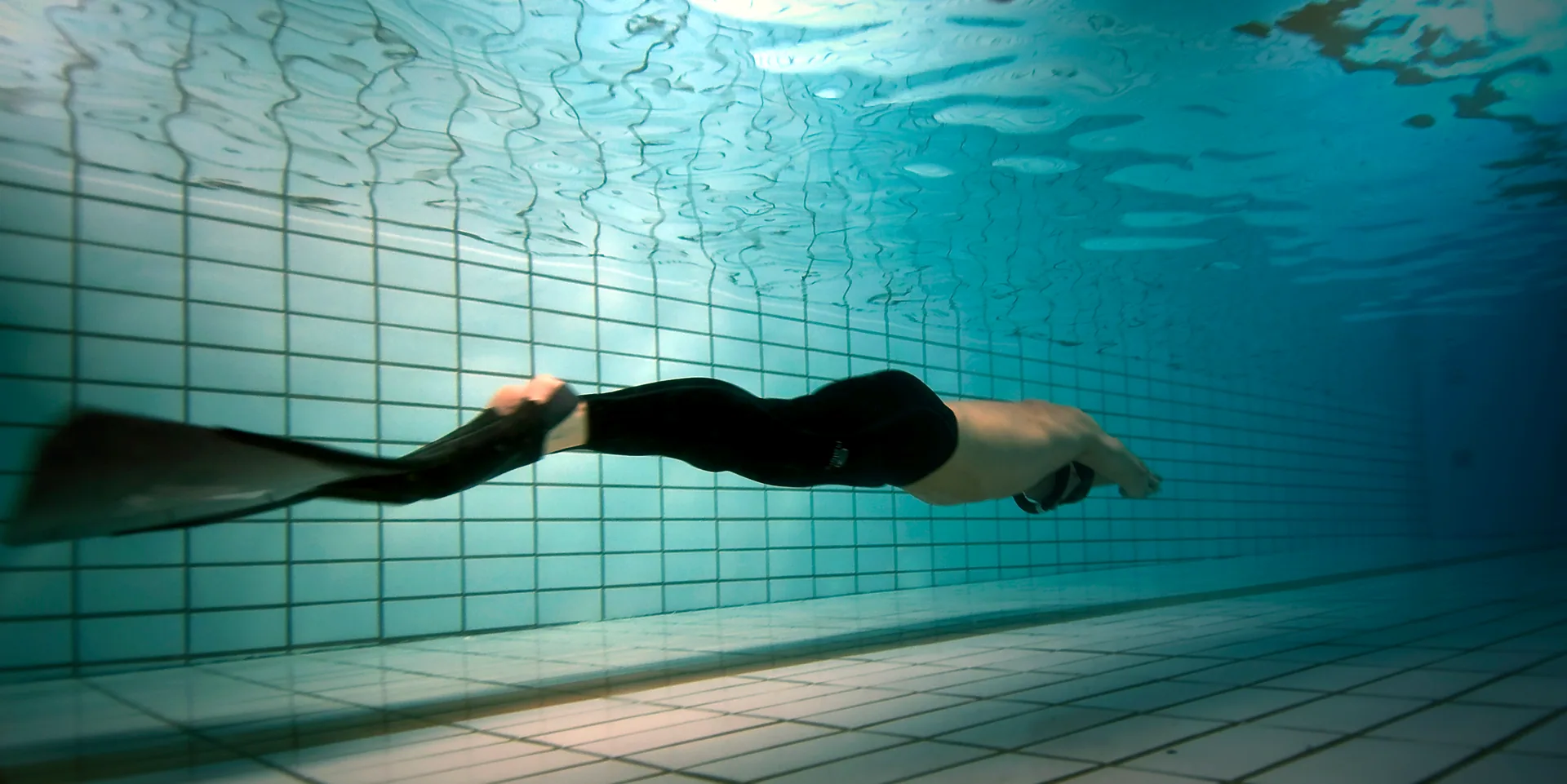
Dynamic apnea with fins requires the athlete to swim horizontally for maximum distance on a single breath using fins (either bifins or monofin). The pool must be at least 25m long. Performance is measured in metres.
The world record exceeds 300m. A competitive beginner level is 100–150m. AIDA 2 requirement is 50m dynamic.
Dynamic Apnea Without Fins (DNF)
Dynamic without fins requires the athlete to swim horizontal for maximum distance using only arms and legs — no fins. This is the technically most demanding pool discipline, requiring a streamlined breaststroke-style pull with minimal energy expenditure.
The world record exceeds 250m. Most beginners find DNF their most challenging discipline.
Depth Freediving Disciplines
Depth competitions are separate from pool competitions and require open water with sufficient depth. Melbourne has limited depth diving directly in Port Phillip Bay — most serious depth training occurs at Kilsby Sinkhole in South Australia or offshore. Depth competitions in Victoria are rare; most Australian depth competitions occur in Queensland.
The main AIDA depth disciplines for reference:
- Constant Weight with Fins (CWT): Dive to maximum depth using fins, return under own power
- Constant Weight Without Fins (CNF): No fins — arms and legs only to depth and back
- Free Immersion (FIM): Pull down a vertical rope, return pulling on the same rope
Australian Freediving Association (AFA)
The AFA is the AIDA-affiliated national body that governs competitive freediving in Australia. It maintains Australian national records, sanctions competitions, and represents Australia at AIDA World Championships.
To enter AFA-sanctioned competitions, you need:
- A minimum of AIDA 2 certification (or recognised equivalent)
- AFA membership (annual fee applies)
- A valid medical clearance in some categories (check current requirements)
The AFA website publishes competition calendars, rules, current national records, and athlete registration. For current information, check the AFA directly — competition schedules change year to year.
Local Melbourne Competitions
Beyond AFA-sanctioned national events, Melbourne has a history of informal and club-level competitions:
Melbourne Freedivers Club Competitions
Melbourne Freedivers Club has historically held informal competitions during pool training nights, though no structured competition programme is currently advertised. Membership is required to participate; certification is encouraged within six months of joining but is not a stated prerequisite. Check directly with the club for current arrangements. Read our Melbourne Freedivers Club review before joining.
School and Community Events
Salt Sessions and other Melbourne schools occasionally run in-house competitions or "challenges" for their student community. These are informal and welcoming to divers who have completed a beginner course.
Finding Current Events
The most reliable way to find current Melbourne competitions:
- AFA website competition calendar
- Freediving club social channels (check current activity before relying on them)
- Salt Sessions and Drifters Freediving social channels
- Freediving Australia Facebook groups
Entering Your First Competition
For most Melbourne freedivers, the first competition is a club-level pool event. Here is what to expect:
Registration
You will submit a performance declaration before the competition — your predicted result for each discipline. This is used to schedule the start order (typically lowest to highest, so the best athletes perform last). As a first-timer, estimate conservatively.
The Day
Arrive early for briefing. Competitions run to a strict timetable — each athlete has a specific start time. Warm-up time in the water is typically scheduled before the competition proper. A judge will be present for each attempt.
Judging and Red/White Cards
After each performance, the judge signals the result:
- White card: Valid performance — your result stands
- Red card: Disqualified — rule violation (usually failure to complete the surface protocol after surfacing)
- Yellow card: Warning (at some competition levels)
The most common cause of red cards for beginners is failing the surface protocol — you must remove your mask and make an "OK" sign within 15 seconds of surfacing. Practice this until it is automatic.
Key Rules & Judging
AIDA competition rules are detailed. Key points for beginners:
- Surface protocol: After surfacing, within 15 seconds: remove mask (or goggles), look at the judge, give "OK" hand signal. Failure = red card.
- No hyperventilation: You cannot breathe faster than normal breathing rate before a static attempt. Judges observe warm-up.
- Official top time (OT): For static apnea, your attempt begins at your declared OT. You can take up to 30 seconds before this, but the clock starts at OT regardless.
- DNS (Did Not Start): If you are not in position to start at your OT, you receive a DNS. Be ready 2–3 minutes early.
- Counterbalance: Competition freediving is conducted with a buddy system in the water. At club events, the club's safety team typically handles this.
For the full rulebook, see the AIDA International website. Club and informal competitions may use simplified rules — confirm with the organiser.
Preparing for a Pool Competition
Practical preparation for your first pool competition:
- Train the surface protocol. After every training dive, practice removing your mask and signalling OK. This must be reflexive.
- Declare conservatively. Declare 5–10% below your training personal best. Competition nerves affect performance. A modest white card beats a red card on a personal best attempt.
- Rest for 48 hours before the event. No intense training in the two days prior. Sleep well.
- Arrive 45 minutes early. Registration, briefing, and warm-up all need time.
- Eat lightly. A heavy meal 1–2 hours before a static or dynamic attempt will make breath-holding significantly harder.
- Bring warm layers. Pool competitions involve a lot of waiting between attempts. Stay warm between dives.
Australian Records & Benchmarks
For context on where Melbourne athletes sit nationally:
- National level STA: 6–8+ minutes
- National level DYN: 175–225+ metres
- Competitive recreational (good club-level): STA 3–5 min, DYN 100–150m
- First competition target: STA 1.5–3 min, DYN 50–100m — perfectly respectable for a first event
Current Australian records are maintained on the AFA website. Victoria has produced national record holders in multiple disciplines.
For certification required to compete, see our certification comparison guide. For breath-hold training to improve pool performance, see our breath hold training guide.