Freediving & Mental Health
The science and lived experience behind how freediving benefits mental wellbeing, from the Blue Mind effect to breathwork, mindfulness, and cold water therapy.
Last updated:
Ask someone why they freedive, and the answers often sound more spiritual than athletic. The silence. The stillness. The feeling of being completely present. The calm that lasts for days afterward.
These are not just poetic descriptions. They are descriptions of measurable physiological and psychological states. Freediving is, in effect, a mental health intervention disguised as a sport — one that combines breathwork, cold water immersion, mindfulness, physical exercise, and deep social connection into a single practice.
This guide explores the science and lived experience behind how freediving benefits mental wellbeing. It is not making medical claims — freediving is not a substitute for professional mental health treatment. But the evidence, both empirical and anecdotal, suggests that freediving offers something powerful for those seeking better mental health, emotional regulation, and a deeper sense of calm in a chaotic world.
Important Note
This guide presents research and lived experience about freediving's potential mental health benefits. It is not medical advice. Freediving is complementary to, not a replacement for, professional mental health treatment. If you are experiencing mental health challenges, please speak to a qualified health professional. Freediving should be practised safely and with proper training — see our safety guide for essential information.
The Blue Mind Effect
In 2012, marine biologist Dr. Wallace J. Nichols published Blue Mind, a book that synthesised decades of neuroscience and psychology research into a single thesis: proximity to water makes us happier, healthier, and more connected.
Nichols coined the term “Blue Mind” to describe the mildly meditative state people enter when near, in, or under water. It is characterised by calm, peacefulness, unity, and a sense of general well-being. This is not metaphor — brain imaging studies show measurable changes in brain activity when people are exposed to aquatic environments, including increased activity in areas associated with emotional regulation and empathy, and decreased activity in areas linked to stress and rumination.
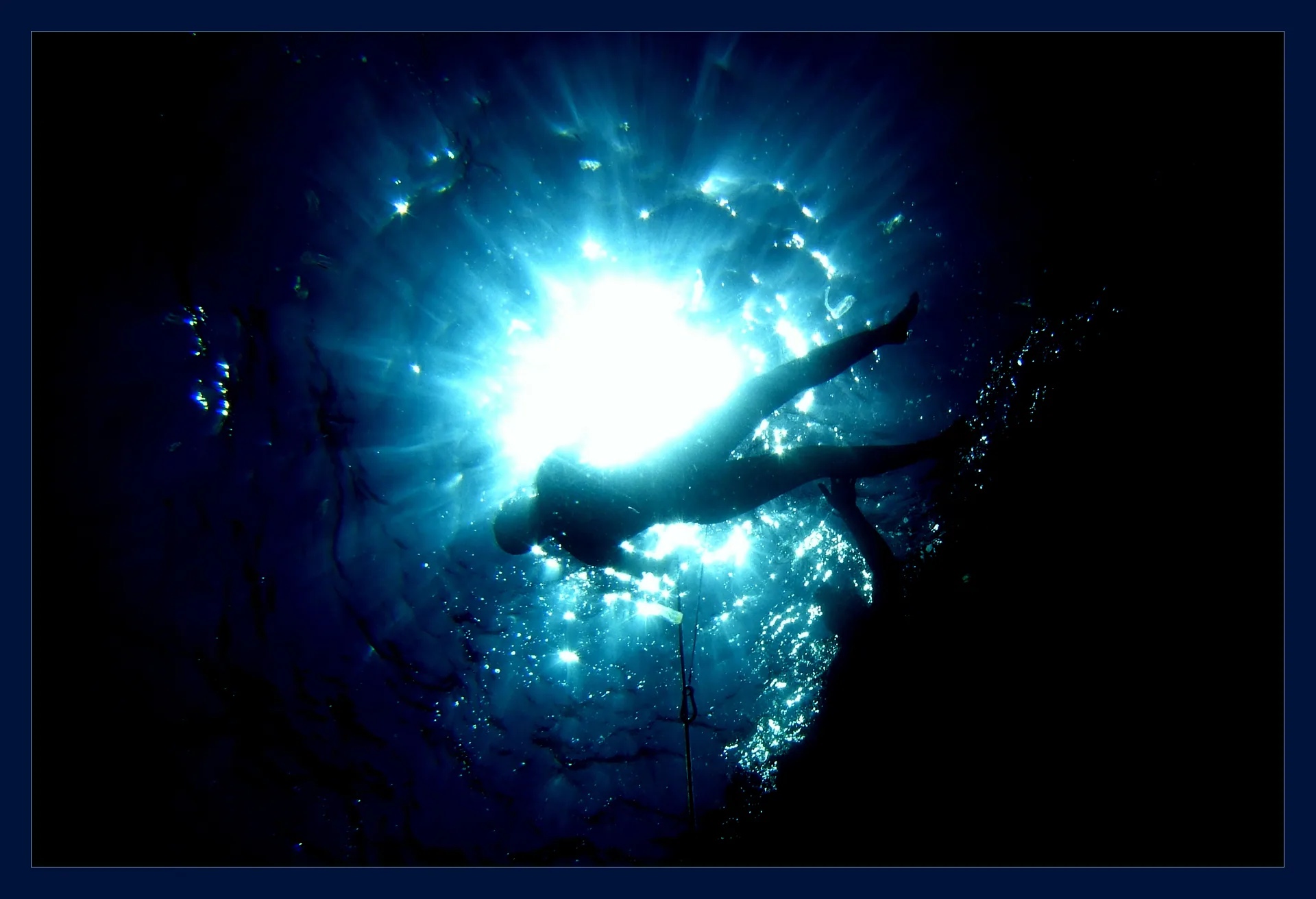
For freedivers, this effect is amplified. You are not just near water — you are immersed in it, weightless, silent, moving through a three-dimensional space that has no analogue in terrestrial life. The sensory experience is unlike anything else: the soft diffusion of light, the muffled silence, the gentle pressure of the water on your skin. These are powerful inputs to a nervous system evolved to respond to environmental cues.
The Science of Blue Spaces
Research published in the journal Health & Place (2013) found that people living near coastlines report better general and mental health compared to those living inland, even when controlling for socioeconomic factors. The effect persists across cultures and climates.
Other studies have shown that even brief exposure to aquatic environments — as little as 10-20 minutes — can reduce cortisol levels (a stress hormone), lower blood pressure, and improve mood markers. The ocean, it turns out, is medicine.
Why Water Heals
The exact mechanisms behind the Blue Mind effect are still being studied, but several factors are at play:
- Sensory novelty: The underwater environment provides a break from the relentless visual and auditory stimulation of modern life. Your brain shifts into a different mode
- Colour psychology: Blue and green hues are consistently associated with calm and relaxation in psychological studies. Underwater, you are surrounded by them
- Negative ions: Water — especially moving water like waves or waterfalls — produces negative ions, which have been linked to improved mood and reduced depression in some research
- Evolutionary response: Humans evolved near water. Access to water meant survival. Our brains may be wired to feel safe and calm in aquatic environments
For Melburnians, this is particularly relevant. Port Phillip Bay is a vast, accessible blue space, and the regular practice of freediving offers repeated exposure to these therapeutic effects. It is not a one-off experience — it is a sustainable mental health practice.
Mammalian Dive Reflex & Nervous System
One of the most fascinating aspects of freediving is the mammalian dive reflex — an ancient physiological response that all air-breathing mammals share. When your face contacts cold water and you hold your breath, your body initiates a cascade of automatic changes designed to conserve oxygen and extend your time underwater.
These changes include:
- Bradycardia: Your heart rate slows, sometimes dramatically (20-50% reduction in experienced freedivers)
- Peripheral vasoconstriction: Blood flow to your extremities is reduced, prioritising oxygen delivery to your brain and vital organs
- Splenic contraction: Your spleen releases stored red blood cells, temporarily increasing oxygen-carrying capacity
From a mental health perspective, the most significant of these is bradycardia — the slowing of the heart rate. This is mediated by the vagus nerve, the primary nerve of the parasympathetic nervous system (the “rest and digest” response). Activating the vagus nerve has a direct calming effect on the entire nervous system. It counteracts the sympathetic nervous system (the “fight or flight” response) that drives anxiety, stress, and hyperarousal.
Vagal Tone & Mental Health
Vagal tone — a measure of how well your vagus nerve functions — is increasingly recognised as a biomarker for mental health. Higher vagal tone is associated with better emotional regulation, resilience to stress, and lower rates of anxiety and depression.
Freediving, through repeated activation of the dive reflex, may improve vagal tone over time. This is supported by research showing that breath-hold training increases heart rate variability (HRV), a marker of vagal tone. You are, in effect, training your nervous system to respond more calmly to stress.
The Immediate Calming Effect
The mammalian dive reflex kicks in within seconds. Put your face in cold water, hold your breath, and your heart rate begins to drop. This is not something you have to think about or work to achieve — it happens automatically. For people struggling with anxiety, panic, or chronic sympathetic nervous system activation, this is a powerful tool.
Some therapists have begun incorporating cold water face immersion (a technique that triggers the dive reflex without full submersion) as an intervention for acute anxiety or panic attacks. The effect is immediate and reliable. Freediving takes this one step further, turning an emergency intervention into a regular practice that builds long-term resilience.
Breathwork for Anxiety
Breath is the interface between the conscious and unconscious nervous system. You breathe automatically, but you can also control your breath intentionally. This makes breathing techniques uniquely powerful for regulating mental and emotional states.
Freediving is, fundamentally, a breathwork practice. Before every dive, you perform a breathe-up — 2-3 minutes of slow, diaphragmatic breathing designed to calm your nervous system and lower your heart rate. You learn to extend your exhales, control your breath rhythm, and enter a state of deep relaxation before taking your final breath. These are the same techniques taught in clinical settings for anxiety, PTSD, and stress management.
Diaphragmatic Breathing
Most people breathe shallowly, using only the upper chest. This type of breathing is associated with stress and anxiety — it activates the sympathetic nervous system. Diaphragmatic breathing (belly breathing) does the opposite: it slows your heart rate, lowers blood pressure, and activates the parasympathetic nervous system.
Freediving trains you to breathe diaphragmatically as a default. You practise it before every dive, in every pool session, and eventually it becomes your normal breathing pattern — not just in the water, but on land as well. This is a transferrable skill with profound mental health implications. You are learning, in effect, to self-regulate your nervous system through breath.
For a detailed guide to the breathing techniques freedivers use, see our breath-hold training guide.
CO2 Tolerance Training
One of the most uncomfortable aspects of a breath-hold is the rising urge to breathe caused by CO2 buildup. CO2 tolerance training — practising breath-holds with increasing discomfort — teaches you to remain calm in the presence of a powerful physiological stressor.
This is not just physical training. It is mental and emotional training. You learn that discomfort is not danger. You learn to observe sensations without reacting to them. You build the capacity to sit with difficult feelings — a core skill in anxiety management and emotional regulation.
This skill transfers to life on land. If you can stay calm with CO2 building in your blood and your diaphragm contracting, you can stay calm in a difficult conversation, a stressful meeting, or a moment of uncertainty. Freediving builds distress tolerance in a very literal, embodied way.
Parallels with Clinical Breathwork
The breathwork techniques used in freediving closely parallel techniques used in evidence-based therapies:
- Box breathing (square breathing): Used in freediving pre-dive preparation. Also used in the military, in trauma therapy, and for acute anxiety management
- Extended exhale breathing: Core to freediving breathe-ups. Also central to vagal nerve stimulation and anxiety reduction protocols
- Slow, controlled breathing: The foundation of practices like HeartMath, Coherent Breathing, and Buteyko method
Freediving gives you a reason to practise these techniques regularly, in a context that is enjoyable and rewarding. You are not doing breathwork because a therapist told you to — you are doing it because it helps you dive deeper, stay calmer, and enjoy the experience more. The mental health benefits are a side effect of pursuing the activity itself.
Mindfulness Underwater
Mindfulness — present-moment awareness without judgement — is one of the most researched mental health interventions of the last two decades. It reduces anxiety, improves mood, enhances emotional regulation, and changes brain structure in measurable ways. It is also notoriously difficult for many people to practise consistently.
Freediving is mindfulness by necessity. When you hold your breath and descend, your mind does not wander. You cannot think about your to-do list, replay a conversation from yesterday, or plan dinner. You are here, now, fully present. If your mind drifts, your body brings it back — through the sensation of pressure, the urge to equalise, the subtle shift in buoyancy. The feedback is immediate and embodied.
Flow State
Psychologist Mihaly Csikszentmihalyi described “flow” as a state of complete absorption in an activity, where action and awareness merge. Flow is associated with deep satisfaction, reduced self-consciousness, and altered perception of time. It is one of the most reliably positive psychological states humans can experience.
Freediving is flow-inducing. The challenge level is high enough to demand full attention, but (with training) not so high that it overwhelms. The feedback is immediate. The environment is inherently rewarding. You lose track of time. Ego dissolves. You are simply there, moving through the water, breathing, being.
This is not something you need to strive for or manufacture. It happens naturally when the conditions are right — which, in freediving, they often are.
Sensory Immersion
Underwater, your senses are flooded with novel input. The play of light on sand. The movement of kelp. The texture of the reef. The sound of your own heartbeat. These are absorbing, grounding sensations that pull you out of your head and into your body.
This is one reason why nature-based therapies (forest bathing, ecotherapy, outdoor adventure programs) are so effective for mental health. They shift attention away from internal rumination and toward external sensory experience. Freediving does this more intensely than almost any other activity.
Digital Disconnection
When you are underwater, you are unreachable. No phone. No notifications. No email. This forced disconnection is, for many people, profoundly relieving. It creates a boundary — a space where the demands of the world simply cannot reach you. Even a 60-minute freediving session offers an hour of complete mental quiet that is increasingly rare in modern life.
Cold Water Immersion Benefits
Melbourne's water is cold. Even in summer, Port Phillip Bay averages 18-23°C. In winter, it drops to 10-13°C. For freedivers, this is not an obstacle — it is an asset.
Cold water immersion has become a focus of increasing research interest, particularly in relation to mental health. Studies have shown that regular cold water exposure can reduce symptoms of depression, improve mood, increase resilience to stress, and boost overall wellbeing.
The Dopamine Response
Cold water exposure triggers a significant release of dopamine and norepinephrine — neurotransmitters associated with alertness, motivation, and mood. A 2000 study published in the European Journal of Applied Physiology found that cold water immersion increased dopamine levels by 250% and norepinephrine by 530%. These are dramatic changes, comparable to those seen with stimulant medications.
Unlike the short-lived spike from caffeine or other stimulants, the mood boost from cold water immersion tends to be sustained. Many cold water swimmers and freedivers report a sense of clarity and elevated mood that lasts for hours or even days after a session. This is not placebo — it is neurochemistry.
Resilience Building
Immersing yourself in cold water is uncomfortable. It demands mental fortitude. Over time, this builds resilience — the capacity to tolerate discomfort and adapt to stressors. Research suggests that people who regularly practise cold water immersion show improved stress resilience in other areas of life. The brain learns that discomfort is survivable, and this learning generalises.
For freedivers, this happens every session. You suit up, you enter cold water, you manage the initial shock, and you adapt. Within minutes, your body adjusts. This is a repeatable lesson in resilience: discomfort does not last. You are more capable than you think.
Cold Adaptation & Mood
There is some evidence — though not yet definitive — that regular cold water immersion may reduce symptoms of depression through adaptive changes in the nervous system. A 2018 case study published in BMJ Case Reports described a woman with severe depression who experienced complete remission after a program of weekly cold water swimming. While a single case study is not proof, it is a compelling data point that has prompted further research.
The proposed mechanism is “cross-adaptation” — the idea that adapting to one stressor (cold water) improves your ability to cope with other stressors (emotional, psychological). For freedivers in Melbourne, this adaptation is built into the activity. You are cold-water training by default.
Community & Connection
Freediving is not a solo sport. The buddy system — the foundational safety protocol in freediving — creates deep, trust-based relationships. You put your life in your buddy's hands every time you dive. They watch you descend, monitor your ascent, and are ready to rescue you if something goes wrong. This is not casual companionship — it is profound mutual reliance.
Social connection is one of the strongest predictors of mental health and wellbeing. Loneliness and social isolation are risk factors for anxiety, depression, and even physical illness. Freediving, by design, builds connection.
Shared Vulnerability
Freediving creates a unique form of intimacy. You see people in moments of discomfort, challenge, and sometimes fear. You see them surface from a deep dive, breathless and grinning. You see them struggle with equalisation, push through mental barriers, and celebrate small victories. This shared vulnerability builds bonds quickly.
In a culture where many people feel isolated despite constant digital connection, this kind of embodied, in-person, reciprocal relationship is increasingly rare and increasingly valuable.
Clubs and Community
Melbourne has an active and welcoming freediving community. Clubs run regular pool sessions and open water dives, creating consistent opportunities for connection. These are not transactional relationships — they are built around shared passion, mutual support, and regular contact.
For people struggling with social anxiety or isolation, joining a freediving club can be a pathway to meaningful connection in a context that feels safe and structured. See our guide to freediving clubs in Melbourne for information on local groups.
Belonging
Humans need to belong. We are tribal creatures. Freediving offers a tribe — a group of people who share a passion, understand your commitment, and welcome you into a community. This is not a trivial benefit. A sense of belonging is protective against mental health challenges and contributes to overall life satisfaction.
Research & Evidence
While freediving as a mental health intervention has not been as extensively studied as some other practices, related research provides strong support for its benefits.
Breath-Hold Training & Anxiety
A 2022 study published in Frontiers in Psychiatry examined the effects of breath-hold training on anxiety and stress in healthy adults. Participants who completed a four-week breath-hold training program showed significant reductions in anxiety scores, improved heart rate variability (a marker of vagal tone), and better emotional regulation compared to controls. The researchers concluded that breath-hold training may be a viable complementary intervention for anxiety management.
Cold Water Immersion & Depression
A 2020 review in the International Journal of Environmental Research and Public Health examined the existing research on cold water swimming and mental health. The review found consistent evidence for mood enhancement, stress reduction, and potential antidepressant effects. The authors noted that more rigorous trials are needed, but the existing evidence is promising.
Blue Space Exposure & Wellbeing
Multiple large-scale studies have found associations between proximity to blue spaces (oceans, lakes, rivers) and better mental health outcomes. A 2019 study published in Health & Place analysed data from over 26,000 people across 14 countries and found that those who visited coastal environments at least twice per week had better general health and psychological wellbeing.
Mindfulness & Flow
The mental health benefits of mindfulness and flow states are well-established. Thousands of studies have documented the effects of mindfulness-based interventions on anxiety, depression, emotional regulation, and stress. Flow states have been linked to increased life satisfaction, creativity, and psychological wellbeing. Freediving facilitates both.
What the Research Suggests
While we need more studies specifically on freediving, the existing research on its constituent elements — breathwork, cold water exposure, blue space contact, mindfulness, social connection — all point in the same direction: these are powerful interventions for mental health and wellbeing.
Freediving combines all of them into a single, integrated practice. It is not unreasonable to hypothesise that the benefits are synergistic — that doing all of these things together, regularly, in a supportive community, produces effects greater than the sum of the parts.
Freediving as Moving Meditation
Many freedivers describe the descent as the closest they have come to a true meditative state. There is a paradox at the heart of it: to dive deeper, you must do less. To extend your breath-hold, you must relax more. Effort is counterproductive. The goal is to surrender.
This mirrors the core teaching of meditation: you cannot force stillness. You can only create the conditions for it to arise. In freediving, those conditions are clear: slow your breath, quiet your mind, let go of tension, and descend.
The Dive as Meditation
A typical freedive follows a pattern that will be familiar to anyone who meditates:
- Preparation (breathe-up): Slow, rhythmic breathing to calm the nervous system and centre your attention. This is the equivalent of settling into a meditation posture and establishing your anchor (breath, mantra, body scan)
- The dive (descent and bottom time): Complete present-moment awareness. The breath is held, and attention narrows to the sensations of the body, the environment, the subtle internal shifts. Thoughts dissolve. Only being remains
- Return (ascent): Gradual transition back to the surface, maintaining calm and focus
- Recovery: Breathing resumes. The mind and body reintegrate. The effects linger
This structure mirrors seated meditation, walking meditation, and other contemplative practices. The difference is that the feedback in freediving is visceral and immediate — you cannot fake it. Either you are calm, or you are not. Your body tells you the truth.
Breath as Anchor
In seated meditation, the breath is often used as an anchor — a point of focus to return to when the mind wanders. In freediving, the breath-hold itself becomes the anchor. The entire practice revolves around the single breath you take before descending. Everything else — equalisation, finning technique, depth — flows from that breath.
This creates a natural meditative focus. You are not trying to watch your breath — you are living it. The breath is the dive.
Stillness in Motion
There is a quality of stillness in a freedive that is hard to describe to someone who has not experienced it. You are moving — descending through the water column, finning along a reef — but there is no sense of effort. You glide. The water holds you. Gravity disappears. Time dilates.
This is stillness in motion. It is what Zen practitioners call “effortless effort.” It is what athletes in flow describe. It is a state where doing and being are not separate. You are not freediving — you are freediving itself.
For many people, this state is the reason they keep coming back. It is the opposite of the noise and pressure of everyday life. It is a refuge.
Getting Started
If you are drawn to freediving for its mental health benefits, you do not need to be an athlete or a strong swimmer. You do not need to dive deep. The benefits are available to anyone willing to take a course, learn the basics, and spend time in the water.
Take a Course
A beginner freediving course (AIDA 1, AIDA 2, SSI Level 1, or Molchanovs Wave 1) teaches you everything you need to know to freedive safely and enjoy the mental health benefits from day one. You will learn breathwork, relaxation techniques, equalisation, and the buddy system. Most courses take 1-2 days and include both pool and open water sessions.
For guidance on choosing a course, see our guide to freediving courses in Melbourne.
You Don't Need to Go Deep
The mental health benefits of freediving do not depend on depth. A shallow dive to 5-10 metres offers the same breathwork, mindfulness, cold water exposure, and social connection as a 30-metre dive. Many experienced freedivers prefer shallow reef dives precisely because they can relax more, observe more, and enjoy the experience without the intensity of deep diving.
If you are interested in freediving primarily for wellbeing, you can stay shallow forever and still receive the full benefits. Depth is optional. Presence is not.
Join a Community
The social and safety benefits of freediving are best experienced through clubs and regular groups. Melbourne has several active freediving clubs that welcome beginners and run supportive, well-organised sessions. You will find training buddies, mentors, and friends.
See our guide to freediving clubs in Melbourne for information on local groups.
Start with Pool Training
If you are nervous about open water, start with pool training. Many clubs run regular pool sessions where you can practice breath-holds, finning technique, and equalisation in a controlled, warm, safe environment. The mental health benefits — breathwork, mindfulness, community — are all available in the pool. Open water can come later.
For information on pool training in Melbourne, see our pool training guide.
Be Patient
The mental health benefits of freediving build over time. Some are immediate — the post-dive calm, the dopamine release from cold water. Others — improved vagal tone, emotional regulation, resilience — develop with regular practice. Think of freediving as a long-term investment in your wellbeing, not a quick fix.
Freediving & Therapy: A Complementary Approach
If you are receiving professional mental health treatment, freediving can be a valuable complement — but it is not a replacement. Talk to your therapist or doctor about adding freediving to your self-care routine. Many mental health professionals are supportive of activities that combine physical exercise, breathwork, mindfulness, and social connection.
If you are on medication, have a history of panic attacks or significant anxiety, or have any concerns about breath-hold activities, discuss it with your healthcare provider before starting freediving.
Frequently Asked Questions
Is freediving good for mental health?
Research and anecdotal evidence strongly suggest yes. Freediving combines breathwork, mindfulness, cold water immersion, physical exercise, and social connection — all evidence-based mental health interventions — into a single activity. Many freedivers report reduced anxiety, improved mood, enhanced present-moment awareness, and a sense of calm that persists long after leaving the water.
How does freediving help with anxiety?
Freediving trains diaphragmatic breathing and CO2 tolerance, which directly activate the parasympathetic nervous system (the “rest and digest” response). The mammalian dive reflex triggers bradycardia (heart rate slowing) and vagal tone improvement. These physiological responses counter anxiety. The practice also builds emotional regulation and resilience through controlled exposure to discomfort.
Is freediving like meditation?
Many freedivers describe it as a form of moving meditation. The breath-hold demands complete present-moment focus, eliminating mental chatter. The sensory environment underwater — silence, weightlessness, blue light — creates conditions similar to deep meditation. The breath itself becomes an anchor, just as in seated meditation practice.
Can beginners experience the mental health benefits?
Yes, from the very first session. The breathwork techniques taught in a Level 1 course have immediate calming effects. Even pool training produces the relaxation response. You don't need to dive deep to benefit — the mental health effects come from the practice itself, not from depth or performance.