Spider Crab Migration Melbourne
The largest crab migration on Earth happens in Port Phillip Bay every winter. Here's how to see it.
Last updated:
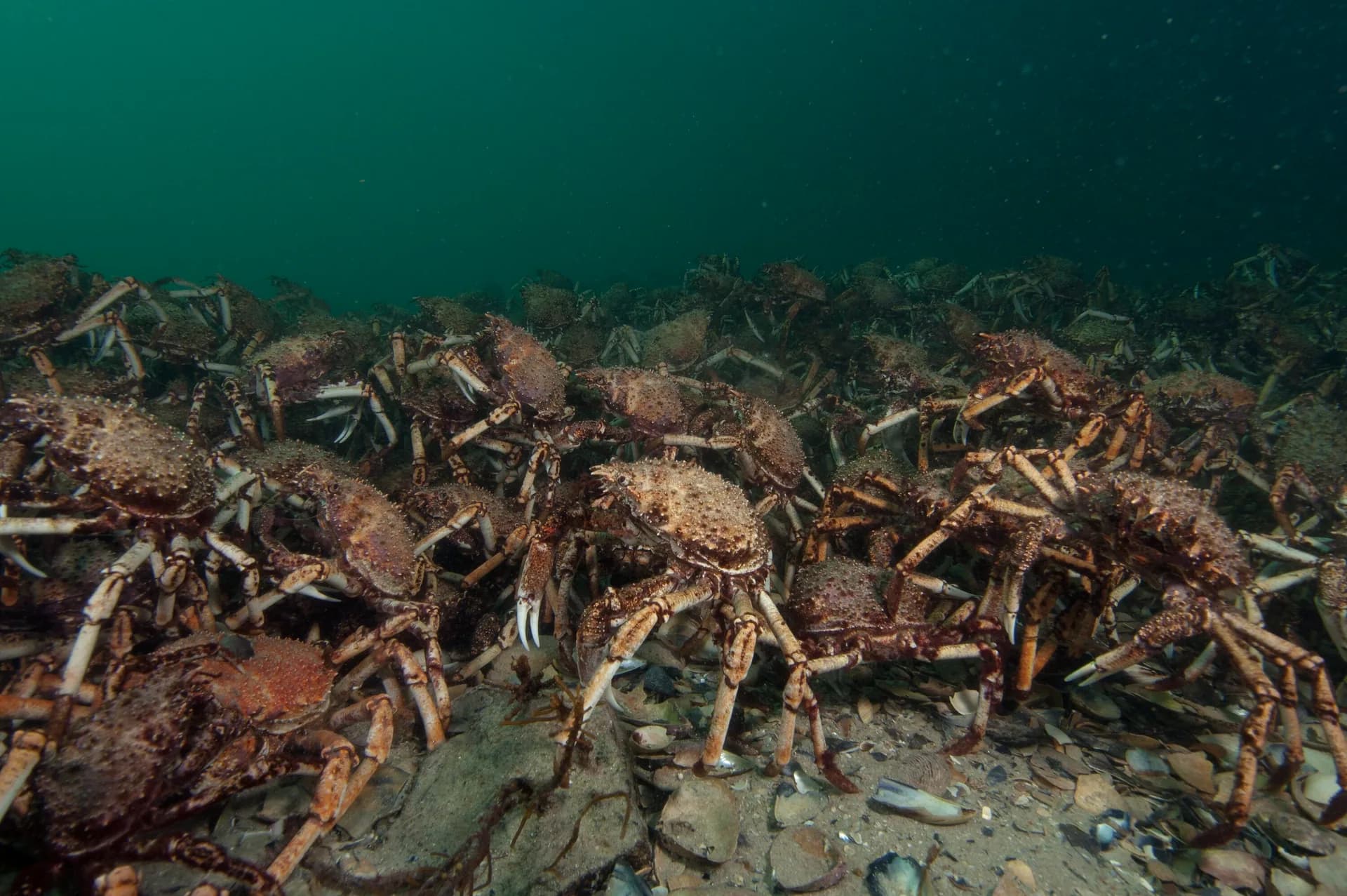
Every winter, on a few unpredictable days, thousands of giant spider crabs climb up from the depths of Port Phillip Bay and blanket the seafloor in shallow water. It is the largest known crab migration on the planet, and it happens in Melbourne's backyard.
The crabs gather in such numbers that the sandy bottom disappears entirely — replaced by a living carpet of melon-sized crabs crawling over each other, moulting out of their old shells, and emerging a brilliant orange. Seals, rays, dolphins, and birds arrive to feed. For a few days, one of the most extraordinary wildlife spectacles on Earth plays out beneath a suburban pier.
You don't need scuba gear to see it. A mask, snorkel, and fins will get you there.
What Are Giant Spider Crabs?
Giant spider crabs (Leptomithrax gaimardii) are native to southern Australian waters. They grow to roughly the size of a rockmelon, with long spindly legs that give them their name. Despite looking intimidating, they're slow-moving, docile, and completely harmless to humans.
Like all crustaceans, spider crabs must shed their hard exoskeleton to grow — a process called moulting. A crab climbs out of its old shell over about an hour, emerging soft, bright orange, and extremely vulnerable. Until the new shell hardens over the following days, the crab is easy prey.
Scientists believe the mass gathering is a survival strategy: safety in numbers. By moulting simultaneously in a huge group, any individual crab's chance of being eaten is dramatically reduced.
When Does It Happen?
The migration typically occurs between late May and mid-June, though the exact timing varies each year. The crabs appear to respond to water temperature and lunar cycles — the gathering often coincides with the approach of a full moon.
The aggregation lasts only a few days. The crabs arrive, moult almost simultaneously, and then disperse back into deeper water. Miss the window and you'll see nothing.
For where the crab season sits in the wider winter diving calendar, see our month-by-month guide to the best time to dive in Melbourne.
How to Know When They've Arrived
The timing is impossible to predict precisely. The only reliable method is to watch for reports from divers. Follow the Facebook group Spider Crabs Melbourne for live sighting updates this winter. When the crabs arrive, word spreads fast through the diving community.
Where to See Them
The crabs gather at different locations in southern Port Phillip Bay each year. Only as the full moon approaches does it become clear where they'll turn up.
Blairgowrie Pier (Most Common)
The most frequent location for the aggregation. The pier and surrounding shallow water have hosted the migration in multiple years. Easy shore access, shallow depth (2-7m), and good infrastructure make this the most popular spot for divers and snorkelers during the migration. For entry points, conditions, and what else lives under the pier, see our full Blairgowrie Pier diving guide.
- Depth: 2-7m
- Entry: Shore — beach entry near the yacht squadron
- Note: Gets very busy during the migration. Arrive early. Be aware of boat traffic
Rye Pier
Another common location. The shallow water around the L-shaped pier is ideal crab habitat. The signposted Octopus Garden trail makes navigation easy, and the gentle depth (2-5m) is accessible for snorkelers. Our Rye Pier snorkeling guide covers the full site.
- Depth: 2-5m
- Entry: Shore — beach entry or pier ladder
Other Possible Locations
Spider crab aggregations have also been reported at Sorrento, St Leonards, and Queenscliff. The crabs don't always return to the same spot, which is part of what makes each year's migration unpredictable and exciting.
How to See the Migration
Freediving and Snorkeling
This is one of the best ways to experience the migration. The crabs gather in shallow water — typically 2-5 metres — meaning you can observe them with nothing more than a mask, snorkel, and fins.
Freediving gives you the advantage of getting down to the seafloor and hovering among the crabs at eye level. You'll see individual crabs mid-moult, newly emerged crabs glowing orange, and the predators that follow — rays gliding over the aggregation, seals picking off stragglers.
- Gear needed: Mask, snorkel, fins, 5-7mm wetsuit (winter water is 10-13°C), weight belt, and a dive float for visibility
- Skill level: Accessible to snorkelers and beginner freedivers. No deep diving required
- Best time of day: Morning offers calmer water and fewer people. The crabs are present day and night. For after-dark options, see our night diving in Melbourne guide
Scuba Diving
Scuba lets you stay on the bottom longer and observe the moulting process up close. Several Melbourne dive shops and schools run spider crab dive trips during the season — check with local operators as the migration window approaches.
From the Pier
When the crabs gather in very shallow water close to shore, you can sometimes see them from the pier itself or while wading. But the real spectacle is underwater — seeing the carpet of crabs stretching out in every direction is something you have to be in the water to appreciate.
What You'll See
The migration is more than just crabs. The sudden concentration of vulnerable, soft-shelled crabs draws predators from across the bay:
- Giant spider crabs — Thousands covering the seafloor, many mid-moult. Discarded shells pile up around the aggregation
- Smooth rays — Glide over the mass, feeding on freshly moulted crabs
- Australian fur seals — Arrive to feast on the easy meal
- Dolphins — Occasionally spotted in the area during the migration
- Birds — Cormorants and other seabirds dive in from above
- Eleven-armed sea stars — Scavenge on moult remains and weakened crabs
Tips for the Best Experience
- Follow Spider Crabs Melbourne on Facebook — This is how you'll know when and where the crabs have arrived. Check daily from mid-May
- Be ready to go at short notice — The window is only a few days. Have your gear packed and ready from late May
- Arrive early — The migration attracts huge crowds of divers, snorkelers, and media. Car parks fill fast, especially on weekends
- Dress warm — Water temperature is 10-13°C during the migration. A 5-7mm wetsuit with hood and gloves is essential. Without proper neoprene, you won't last long enough to see much
- Bring a torch — Even during the day, a torch helps illuminate the crabs and reveals details of the moulting process
- Photograph carefully — Avoid using flash directly on moulting crabs. Natural light or a gentle torch beam is less disruptive
- Watch your buoyancy — Don't land on the crabs. Hover above them or move alongside the aggregation at a slight distance
- Try a weekday — If you can take a day off work, weekday mornings are dramatically quieter than weekends
Conservation
The spider crab migration is a globally significant wildlife event. In recent years, it has been increasingly targeted by harvesters — people collecting large numbers of freshly moulted crabs during the most vulnerable moment of their lifecycle.
Conservation groups including the Victorian National Parks Association (VNPA) are campaigning for a no-take period during the moulting season. Their Crab Watch citizen science program collects data on spider crab sightings to support protection efforts.
If you see spider crabs during the migration, you can contribute to the research by reporting your sighting through the citizen science platform iNaturalist. Note the location, date, approximate number of crabs, and whether moulting was observed.
Help Protect the Migration
If you witness harvesting during the moulting aggregation, you can report it to the Victorian Fisheries Authority on 13FISH (133 474). While currently legal, increased reporting builds the case for seasonal protection.
Safety
- Never dive alone — The migration sites get crowded underwater. Dive with a buddy and stay together
- Use a dive float — Visibility from the surface is critical when boats and jet skis are in the area. A brightly coloured float is essential
- Cold water is the main hazard — At 10-13°C, hypothermia is a real risk without proper exposure protection. Don't underestimate winter water. Our guide to cold water freediving in Melbourne covers wetsuits, session planning, and hypothermia signs
- Watch for boat traffic — Blairgowrie is an active boat pier. Stay within designated diver areas and stay visible
- Don't touch the crabs — Newly moulted crabs are extremely fragile. Their soft shells can be damaged by handling, and the stress can be fatal
Frequently Asked Questions
When is the spider crab migration in Melbourne?
The migration typically occurs between late May and mid-June, though exact timing varies each year. The crabs gather over just a few days, often around the full moon. Follow the Facebook group Spider Crabs Melbourne for live updates.
Where do the spider crabs gather?
Most commonly around Blairgowrie Pier on the Mornington Peninsula. They have also been seen at Rye Pier, Sorrento, St Leonards, and Queenscliff. The exact location changes each year.
Can you snorkel with spider crabs?
Yes. The crabs gather in very shallow water (2-5 metres), making them fully accessible to snorkelers and freedivers. You do not need scuba gear. A mask, snorkel, fins, and a winter wetsuit are all you need.
Are spider crabs dangerous?
No. Giant spider crabs are docile and completely harmless to humans. Their claws are not powerful enough to cause injury. However, avoid handling them — newly moulted crabs are extremely vulnerable.
Can you eat spider crabs from Port Phillip Bay?
While currently legal to harvest, there is growing concern about the impact on populations. Conservation groups are calling for a no-take period during the moulting season. Many in the diving community believe the migration should be protected, not harvested.