Diving with Cuttlefish in Melbourne
Encountering the world's largest cuttlefish — intelligent, colour-changing masters of camouflage that will look you in the eye and challenge your understanding of what an animal can be.
Last updated:
A giant Australian cuttlefish hovering in front of you, pulsing with waves of colour, its W-shaped pupils tracking your every movement, is one of the most mesmerising encounters you can have in Melbourne's waters.
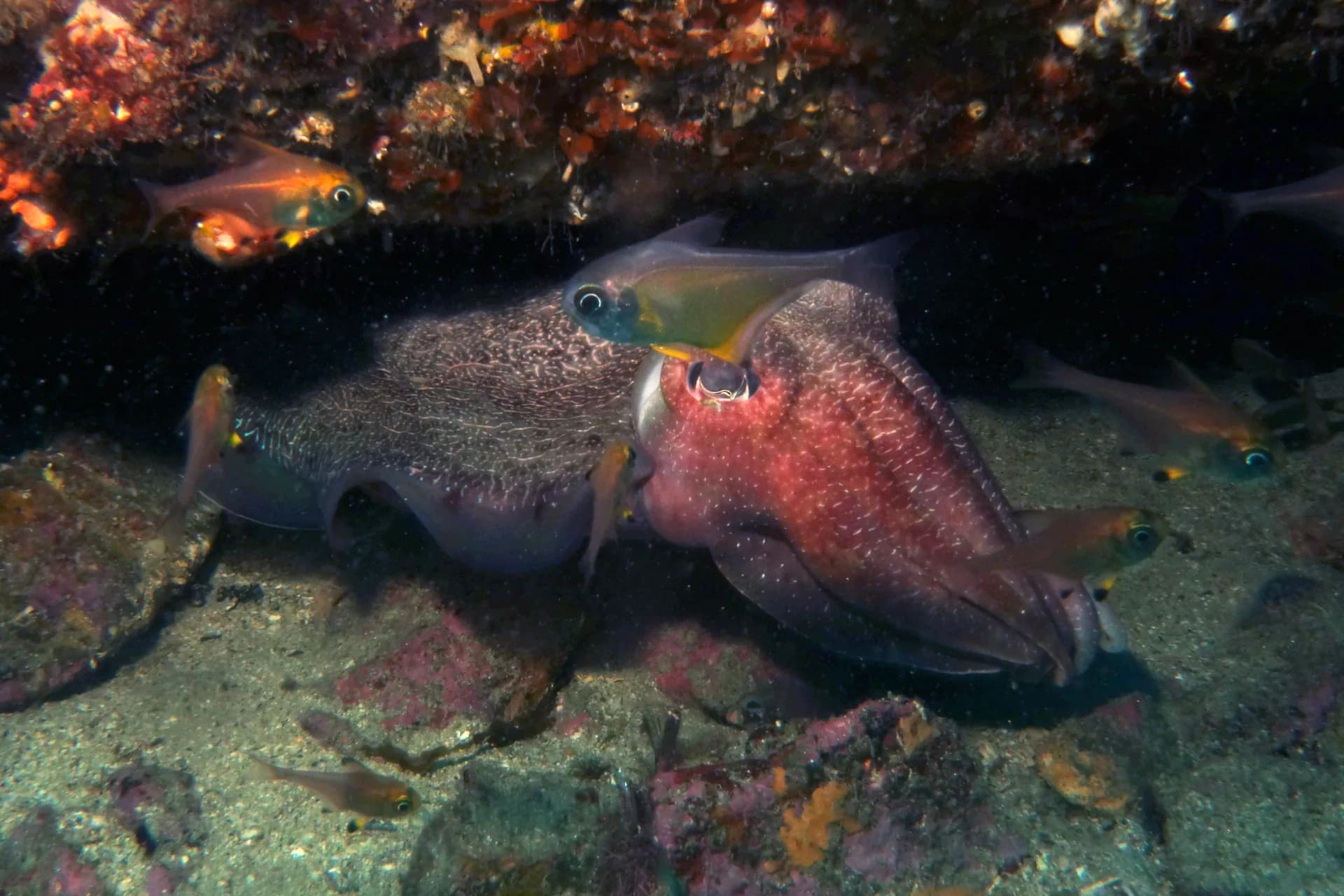
These remarkable cephalopods — the largest cuttlefish species on Earth — inhabit the pier sites and reefs around Port Phillip Bay and the Mornington Peninsula. They're present year-round, but during the autumn breeding season they become bold, theatrical, and almost absurdly approachable. Males compete with dazzling colour displays. Females assess potential mates with what can only be described as scepticism. And if you're a freediver who knows how to stay still, you'll get encounters that scuba divers can only dream of.
This guide covers where to find cuttlefish in Melbourne, when to dive with them, how they behave, why freedivers have the advantage, and how to photograph them without scaring them off. If you've ever wondered what it's like to lock eyes with an animal that has three hearts and can change the colour and texture of its skin faster than you can blink, read on.
Giant Australian Cuttlefish Overview
The giant Australian cuttlefish (Sepia apama) is the world's largest cuttlefish species. Males can reach 50 centimetres in mantle length and weigh up to 10 kilograms, though most individuals you'll encounter in Melbourne waters are in the 20-40 centimetre range. Females are typically smaller than males.
Despite the name, cuttlefish are not fish — they're cephalopods, a group that includes octopus, squid, and nautilus. What sets cuttlefish apart from their relatives is the internal cuttlebone, a gas-filled chambered structure that provides buoyancy control. This allows cuttlefish to hover effortlessly in the water column without sinking or rising, a trick that neither octopus (which lack a buoyancy organ) nor squid (which must keep moving to stay neutral) can match.
Cuttlefish are among the most intelligent invertebrates on the planet. They have large brains relative to body size, excellent vision with W-shaped pupils that give them a wide field of view, and the ability to solve complex problems. Studies have shown that cuttlefish can count, delay gratification, and remember specific events — cognitive abilities once thought to be unique to vertebrates.
But their most famous trait is their ability to change colour and texture almost instantaneously. Unlike most animals that change colour slowly through hormonal processes, cuttlefish use chromatophores — pigment-containing cells controlled directly by muscles and nerves. A cuttlefish can go from brown to striped to bright white in less than a second, shifting through patterns faster than your brain can process. It's hypnotic to watch.
Where to Find Them
Giant Australian cuttlefish are found along the southern coast of Australia from southern Queensland to Western Australia, but the Melbourne region offers some of the most accessible and reliable encounters. Here's where to look.
Flinders Pier (Best Site)
Flinders Pier is the most reliable site in the Melbourne region for encountering giant cuttlefish. The old pier pylons, sponge gardens, and surrounding seagrass beds create ideal cuttlefish habitat, and you're more likely to see cuttlefish here than at any other pier site in the bay.
Cuttlefish at Flinders can be found at any depth from 2 to 10 metres, but they're most commonly seen around the old pier pylons in 4-7 metres of water. During the breeding season (March-May), you may see multiple individuals competing for territory or mates. At night, cuttlefish are almost guaranteed — they're drawn to torchlight and will often hover directly in front of you, mesmerised by the beam.
Blairgowrie Pier
Blairgowrie Pier also supports a healthy cuttlefish population. The pier's sponge-encrusted pylons and sandy bottom provide good habitat, and cuttlefish are regularly seen both during the day and at night. Blairgowrie's calmer conditions compared to Flinders make it a good alternative on days when Western Port is rough.
Portsea Pier
Portsea Pier, with its kelp forests and rocky reef, offers a different environment where cuttlefish are occasionally encountered. They're less common here than at Flinders or Blairgowrie, but the kelp provides excellent camouflage opportunities, and cuttlefish seen at Portsea are often large, mature individuals.
Rye Pier
Rye Pier's sandy bottom and seagrass beds are ideal cuttlefish habitat, particularly for hunting. Cuttlefish are regularly seen here, especially in the Octopus Garden area where the rubble and low-profile reef provide shelter. Night dives at Rye frequently produce cuttlefish encounters.
Sorrento Pier
Sorrento Pier occasionally hosts cuttlefish, particularly in deeper water at the end of the pier. They're less common here than at the sites above, but sightings do occur, especially during the breeding season when cuttlefish are on the move.
Where to Look
Cuttlefish often hover just above the bottom, blending in perfectly with the sand or rubble. Look for the outline of the mantle, the telltale W-shaped pupils, or the faint shimmer of chromatophores firing. Once you spot one, stay still — sudden movement will cause them to jet away in a cloud of ink.
Breeding Season
Autumn — March through May — is the breeding season for giant Australian cuttlefish in southern Australian waters, and this is when encounters in Melbourne are most reliable and dramatic.
During breeding season, male cuttlefish adopt brilliant displays of colour and pattern to attract females and intimidate rival males. Large males display bold zebra-like stripes and pulsing waves of colour, signalling dominance. Smaller males often adopt a mottled brown pattern and try to sneak past the larger males unnoticed — a strategy known as "sneaker male" behaviour.
Females, meanwhile, are far more selective. They assess males based on size, colour intensity, and behaviour, and will reject suitors who don't meet their standards. When a female accepts a mate, the male deposits a sperm packet near her mouth using a specialised arm. The female then stores the sperm and, over the following days, lays hundreds of grape-sized eggs on hard surfaces — typically under pier pylons, on rocks, or attached to kelp holdfasts.
The eggs are white at first, turning black as the embryos develop. If you're diving at Flinders or Blairgowrie in late autumn or early winter, check the undersides of the pier pylons — you'll often find clusters of developing cuttlefish eggs. After laying, the female dies. The male, exhausted from weeks of displaying and competing, also dies. Cuttlefish are semelparous — they breed once and die.
For divers and freedivers, the breeding season is the best time to witness cuttlefish behaviour at its most intense. Males will tolerate your presence if you stay still, and you'll see colour changes, competitive displays, and courtship behaviour that's otherwise rare to observe.
Behaviour
Understanding cuttlefish behaviour is key to getting close encounters. These are intelligent, curious animals with complex communication methods and surprisingly sophisticated hunting techniques.
Colour Changing and Communication
Cuttlefish are masters of camouflage, capable of matching the colour, pattern, and even texture of their surroundings in less than a second. This is achieved through three types of skin cells: chromatophores (pigment-filled sacs that expand and contract), iridophores (reflective cells that produce iridescent blues and greens), and leucophores (white reflective cells). The chromatophores are controlled by muscles connected directly to the nervous system, allowing near-instantaneous changes.
Cuttlefish use colour change for three main purposes: camouflage (blending into the background to avoid predators or ambush prey), communication (displaying patterns to rivals or potential mates), and signalling (flashing bright colours to startle predators or prey).
During the breeding season, males produce a dazzling array of patterns. The "intense zebra" display — bold black and white stripes covering the body — signals dominance and aggression. The "passing cloud" display — waves of dark colour rippling along the body — is used during courtship. And the mottled brown "camouflage" pattern is the default resting state.
What's remarkable is that cuttlefish are colourblind. Despite being able to produce a rainbow of colours and patterns, they see the world in shades of grey. How they manage to match their surroundings so precisely without colour vision remains one of the great mysteries of cephalopod biology.
Hunting Techniques
Cuttlefish are ambush predators. Their primary hunting strategy is to camouflage themselves against the sand or rubble, wait for prey — usually crabs, shrimp, or small fish — to wander close, and then strike with their two long feeding tentacles. The tentacles shoot out from a concealed pocket beneath the arms, grab the prey, and pull it back to the beak, all in a fraction of a second.
Sometimes, cuttlefish will "mesmerise" prey by pulsing waves of colour along their body, creating a hypnotic effect that seems to freeze small crabs and fish in place. Whether this is a deliberate hunting tactic or simply a side effect of the cuttlefish's excitement is still debated, but it's extraordinary to watch.
Cuttlefish also hunt at night, when many of their prey species are more active. This is why night dives at pier sites so often produce excellent cuttlefish encounters — you're diving when they're actively hunting.
Curiosity and Intelligence
Cuttlefish are curious animals. Unlike many marine creatures that flee at the sight of a diver, cuttlefish will often approach to investigate. They're particularly curious about freedivers, who move slowly and produce no bubbles. A cuttlefish may hover a metre or two in front of you, studying you with its large, W-shaped pupils, its body shifting through subtle colour changes as it processes what you are.
If you stay completely still, the cuttlefish may drift closer. Some individuals will come within arm's reach, close enough to see the fine texture of their skin and the rapid firing of chromatophores. It's a profound experience — you're being assessed by an intelligence utterly unlike your own.
Sudden movements, however, will trigger an escape response. The cuttlefish will jet backward by expelling water through its siphon, often releasing a cloud of brown ink as a decoy, and disappear into the gloom. If this happens, stay still and wait. Cuttlefish have short-term curiosity but also short-term memory for threats — if you remain motionless, the same individual may return a few minutes later to investigate again.
Night Encounters
Night diving transforms cuttlefish encounters. During the day, cuttlefish are often cautious, maintaining distance and relying on camouflage to avoid detection. At night, they become bolder, more approachable, and seemingly mesmerised by artificial light.
When you illuminate a cuttlefish with a torch beam, it will often freeze in place, hovering motionless in the water column, its skin rippling with waves of colour. The effect is hypnotic — the cuttlefish seems as fascinated by the light as you are by the cuttlefish. This behaviour allows for incredibly close encounters and makes night diving at sites like Flinders Pier the best way to observe cuttlefish behaviour in detail.
Night dives also reveal cuttlefish hunting behaviour. You may see a cuttlefish stalking a crab across the sand, its body colour shifting to match the bottom, its arms spread wide. Then, in an explosion of movement, the feeding tentacles shoot out, the crab is seized, and the cuttlefish jets away with its prize.
Night Diving Tip
When you encounter a cuttlefish at night, keep your torch on it but move very slowly. Fast movements or sudden changes in light direction will spook it. If you stay calm and still, the cuttlefish will often drift closer, drawn by curiosity. Some individuals will come so close you could touch them — but don't. Observing without touching is always the rule.
The Freediving Advantage
Freedivers have a significant advantage when it comes to encountering cuttlefish. The reason is simple: bubbles.
Scuba divers generate a constant stream of noisy bubbles with every breath. To a cuttlefish — a prey animal that must constantly assess threats — bubbles signal a large, potentially dangerous presence. Most cuttlefish will maintain a cautious distance from scuba divers, retreating if the diver approaches too closely.
Freedivers, by contrast, are silent. No bubbles, no mechanical noise, just a smooth, quiet descent. To a cuttlefish, a freediver looks like just another large fish or marine mammal — non-threatening and even intriguing. As a result, cuttlefish are far more likely to tolerate close approaches from freedivers, and often display curiosity rather than fear.
The best freediving technique for cuttlefish encounters is to descend slowly to the bottom, settle into a comfortable position (lying on the sand or gently holding onto a rock or pylon), and simply wait. Breathe slowly on the surface between dives to extend your bottom time. A cuttlefish that initially kept its distance may, after a minute or two of you remaining motionless, drift closer to investigate. Some individuals will approach to within a metre, their W-shaped pupils tracking you, their skin rippling with subtle colour shifts.
This is the magic of freediving with cuttlefish — you become part of their world rather than an intrusive presence. The encounters feel mutual, collaborative even, as if the cuttlefish has chosen to interact with you rather than being observed against its will.
For more on freediving techniques and the best sites to practice them, see our guide to Melbourne's best freediving spots.
Photography Tips
Cuttlefish are extraordinary photography subjects, but they require patience and the right approach. Here's how to capture them without scaring them away.
Approach and Positioning
The golden rule: let the cuttlefish come to you. If you chase a cuttlefish, it will retreat. But if you descend to the bottom, stay perfectly still, and wait, many cuttlefish will eventually approach out of curiosity.
When you spot a cuttlefish, make slow, deliberate movements to position yourself. Lower yourself to the bottom, establish neutral buoyancy, and point your camera in the general direction of the animal without moving closer. Wait. The cuttlefish may hover at a distance, watching you. After 30 seconds or a minute, it may drift closer. This is when you can begin to compose your shot.
Camera Settings
Cuttlefish require fast shutter speeds to freeze their movement — they can jet away in an instant. Aim for at least 1/125th of a second, and 1/200th or faster if your lighting allows.
A strobe or video light is essential for bringing out the vivid colours and texture of the cuttlefish's skin. Without artificial light, cuttlefish appear washed out and dull in photos. With light, the chromatophores, iridophores, and texture become dramatically visible.
Use a narrow aperture (f/8 to f/11) to ensure the entire cuttlefish is in focus — depth of field can be shallow when shooting close-up subjects.
Focus on the Eyes
The W-shaped pupil is the most striking feature of a cuttlefish. Always focus on the eye. A sharp, well-exposed eye will make the photo, even if other parts of the frame are soft. Cuttlefish eyes are large, expressive, and alien — they're what makes the encounter feel like genuine eye contact with an intelligent being.
Shoot at Their Level
Position yourself at the same level as the cuttlefish rather than shooting down from above. Eye-level or slightly below creates a more intimate, engaging composition and shows the texture and shape of the mantle and arms.
Capture Behaviour
The most compelling cuttlefish photos are the ones that show behaviour — a cuttlefish in mid-colour change, a male displaying to a rival, a cuttlefish stalking prey, or two individuals interacting. During the breeding season, you'll have the best opportunities to capture this kind of dynamic behaviour.
Be Patient
Cuttlefish photography is a waiting game. You may spend five or ten minutes with a single individual before you get the shot you want. Resist the temptation to move on quickly. The longer you stay with a cuttlefish, the more comfortable it becomes with your presence, and the closer and more natural the encounter becomes.
For more on underwater photography techniques and equipment, see our underwater photography guide.
Best Conditions
Cuttlefish encounters are possible in almost any conditions, but certain factors improve your chances of seeing them and getting quality interactions.
- Calm days: Cuttlefish are easier to find and approach when the water is calm. Rough, surge-affected conditions make it difficult to stay still on the bottom, and cuttlefish are less likely to linger in turbulent water
- Good visibility: Visibility of 5 metres or better allows you to spot cuttlefish from a distance and observe their behaviour without crowding them. On poor visibility days (<3 metres), you may swim right past a cuttlefish without noticing it
- Breeding season (March-May): This is peak cuttlefish activity. Males are displaying, competing, and far more conspicuous than at other times of year. Encounters are more frequent and behaviour is more dramatic
- Night dives: As discussed earlier, night dives produce some of the best cuttlefish encounters. Cuttlefish are active hunters at night, and the torchlight seems to mesmerise them, making for closer, longer interactions
- Pier sites over open reef: Cuttlefish are more reliably found at pier sites like Flinders and Blairgowrie than at open ocean reef sites. The structure of the pier pylons, combined with the sandy bottom, provides ideal habitat
Seasonal Calendar
Here's a month-by-month guide to cuttlefish encounters in Melbourne.
January – February (Late Summer)
Cuttlefish are present but relatively quiet. They're feeding and building energy reserves for the upcoming breeding season. Encounters are possible but less frequent. Water is warm (18-22°C).
March – May (Autumn / Breeding Season)
Peak cuttlefish season. Males adopt bold colouration and compete for territory and mates. Females lay eggs on pier pylons and rocky surfaces. This is the best time to witness courtship displays, male competition, and close encounters. Cuttlefish are conspicuous, bold, and relatively tolerant of divers. Water temperature begins to drop (15-19°C).
June – August (Winter)
Breeding season tapers off. Many adult cuttlefish die after breeding, and juvenile cuttlefish begin to appear. Eggs laid in autumn hatch in late winter, and tiny cuttlefish — just 1-2cm long — can be spotted on night dives. Water is cold (10-14°C) but visibility is often excellent.
September – November (Spring)
Juvenile cuttlefish grow rapidly. You'll see small individuals (5-15cm) around the pier pylons, already displaying impressive colour-changing abilities. Adults are less conspicuous during this period. Water temperature begins to rise (12-17°C).
December (Early Summer)
Cuttlefish are present and feeding, building energy for the next breeding season. Encounters are possible but less dramatic than during autumn. Water warms up (16-20°C).
For a broader overview of seasonal marine life, see our guide to the best time to dive in Melbourne.
Cuttlefish vs Squid vs Octopus
Cuttlefish, squid, and octopus are all cephalopods, but they have distinct differences. Here's how to tell them apart underwater.
Cuttlefish
- Body shape: Broad, flattened mantle with a fin running along each side
- Arms: Eight short arms plus two longer retractable feeding tentacles hidden beneath
- Behaviour: Hover in mid-water or sit on the bottom; move slowly with undulating fins or jet backward using the siphon
- Internal structure: Possess a cuttlebone (internal buoyancy organ)
- Camouflage: Masters of colour change and texture matching; can produce complex patterns instantly
Squid
- Body shape: Elongated, torpedo-shaped mantle with triangular fins at the tail end
- Arms: Eight short arms plus two very long feeding tentacles
- Behaviour: Almost always in motion; rarely sit still; fast swimmers that jet through open water
- Internal structure: Possess a pen (thin internal support rod) rather than a cuttlebone
- Habitat: Usually seen in open water or around pylons at night; less likely to sit on the bottom
- Melbourne species: Southern calamari and dumpling squid (bobtail squid) are the most commonly encountered
Octopus
- Body shape: Rounded mantle (head) with no fins; soft-bodied and highly flexible
- Arms: Eight arms of equal length, each lined with suction cups; no retractable tentacles
- Behaviour: Typically hide in dens (holes, crevices) during the day; emerge at night to hunt; crawl along the bottom using their arms rather than swimming
- Internal structure: No cuttlebone or pen; entirely soft-bodied except for the beak
- Camouflage: Excellent colour change and texture matching, though generally slower to change than cuttlefish
- Melbourne species: Common Sydney octopus and blue-ringed octopus
Quick Identification Tips
If it's hovering mid-water with undulating side fins → cuttlefish. If it's jetting through open water and rarely sits still → squid. If it's tucked in a hole or crawling along the bottom with eight arms → octopus.
Frequently Asked Questions
Where can you see cuttlefish in Melbourne?
Flinders Pier is the most reliable site for encountering giant Australian cuttlefish in the Melbourne region, followed by Blairgowrie, Portsea, and Rye piers. They are present year-round but are most active and visible during the autumn breeding season (March-May). Night dives at these pier sites also produce excellent cuttlefish encounters throughout the year.
When is the best time to see cuttlefish in Melbourne?
Autumn (March-May) is the breeding season when cuttlefish are most active and display their remarkable colour-changing abilities. During this period, males compete for females with dramatic displays, and females lay eggs on hard surfaces under the piers. Night dives year-round also produce excellent encounters as cuttlefish are naturally attracted to torchlight and are more approachable after dark.
Do cuttlefish approach divers?
Yes, giant Australian cuttlefish are naturally curious and intelligent animals that will often approach quiet, still divers — especially freedivers who produce no bubbles. If you remain motionless on the bottom, a cuttlefish may drift toward you to investigate, coming within arm's reach and studying you with their large W-shaped pupils. Sudden movements will cause them to jet away, but patience is almost always rewarded.
How big do cuttlefish get in Melbourne?
Giant Australian cuttlefish (Sepia apama) can reach 50cm in mantle length and weigh up to 10kg, making them the largest cuttlefish species in the world. Most individuals seen at Melbourne pier sites are in the 20-40cm range, though larger specimens are occasionally encountered. Males are typically larger than females and display more intense colouration during the breeding season.