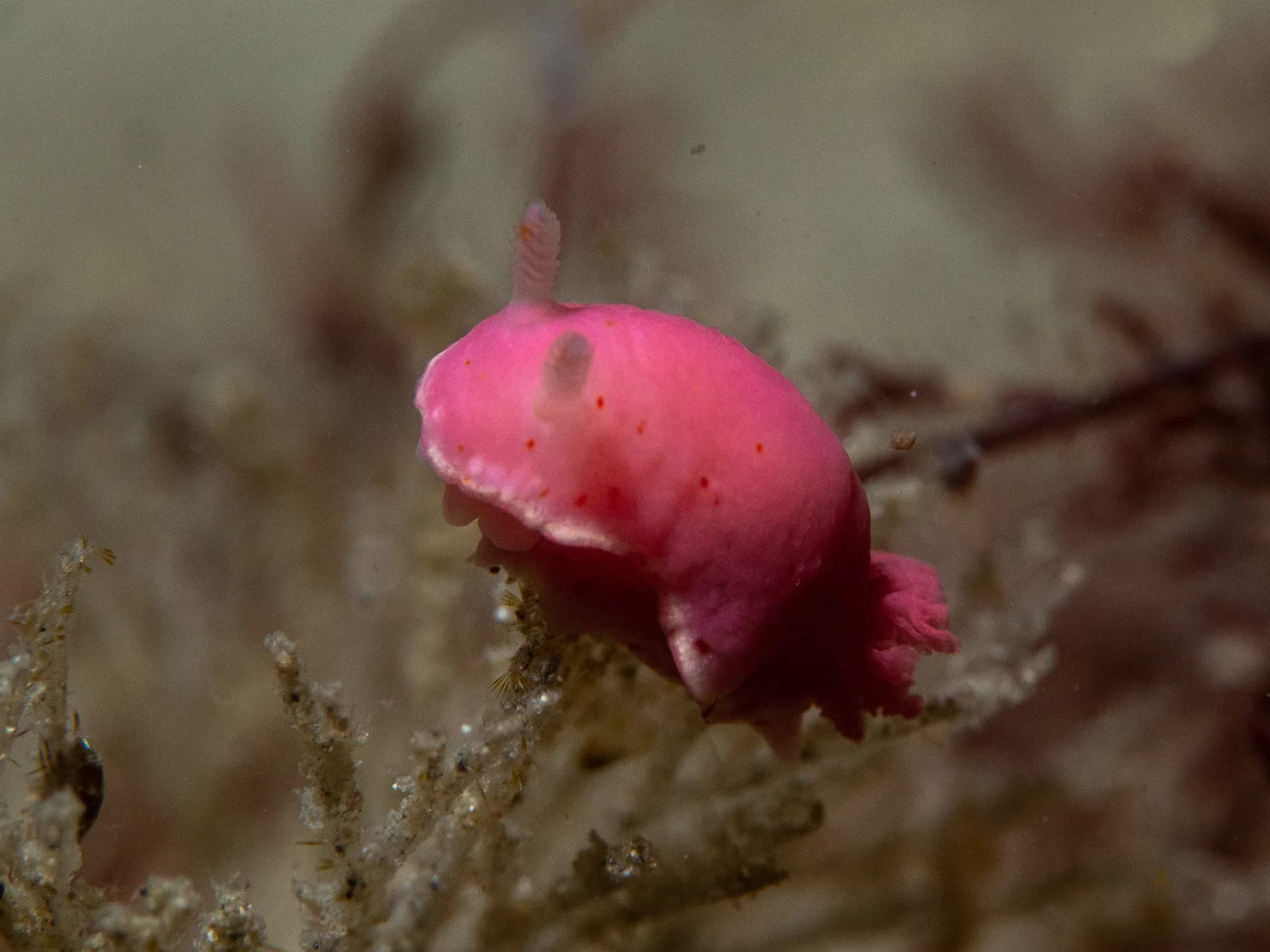
Underwater Photography Melbourne Guide
From your first compact camera to a professional mirrorless rig — everything you need to capture Melbourne's extraordinary underwater world, from weedy seadragons to vivid sponge gardens.
Last updated:
Melbourne's underwater world is one of the most photogenic temperate marine environments on the planet — and most people have no idea it exists.
Beneath the piers and rocky reefs of Port Phillip Bay and Western Port, you'll find weedy seadragons drifting through sponge-encrusted pylons, nudibranchs in every colour imaginable carpeting every surface, octopus hunting through rubble gardens, and kelp forests swaying in the current. The marine life here rivals tropical destinations for sheer diversity, and in many ways surpasses them for character and drama.
The challenge? Melbourne's waters are not tropical. Visibility is typically 3-8 metres. The water carries a green tint from suspended phytoplankton. Light drops off quickly with depth. These conditions demand a different approach to underwater photography than what you'll read in most guides written for clear tropical water. Get the approach right, however, and the results can be spectacular.
This guide covers everything you need to know to start capturing stunning underwater images in Melbourne — from choosing your first camera to editing the final shot. Whether you're a freediver, scuba diver, or snorkeler, and whether your budget is $700 or $15,000, there's a path into underwater photography that works for you.
Camera Gear: Choosing the Right System
The single most common question from people wanting to get into underwater photography is "what camera should I buy?" The answer depends on your budget, your diving experience, and how seriously you want to pursue the craft. There are three main categories of camera system, each with distinct trade-offs.
Compact Cameras (Best for Beginners)
Compact cameras are the ideal starting point for underwater photography in Melbourne. The standout option is the Olympus TG-7 (also sold as the OM System TG-7). This camera is waterproof to 15 metres without any housing, shoots RAW files, has an excellent microscope macro mode, and costs under $700. For freediving at Melbourne's shallow pier sites where most of the action happens between 1 and 7 metres, the TG-7 handles the conditions remarkably well.
The TG-7's key advantages for freedivers are its compact size, one-hand operation, and ruggedness. You can clip it to your BCD or wetsuit, descend to the bottom, and start shooting immediately without fussing with controls. The macro mode produces surprisingly sharp close-up images of nudibranchs, seahorses, and small marine life — the subjects that Melbourne's pier sites are famous for.
Other compact options include the Sony RX100 series (which requires a separate housing) and various action cameras like GoPro. Action cameras are fine for video but limited for stills due to their fixed wide-angle lens and small sensor.
Mirrorless Cameras (Best Balance)
Mirrorless cameras offer the best balance of image quality, flexibility, and portability for serious underwater photographers. Systems from Sony (A7 series), Nikon (Z series), and OM System (OM-1) are all popular choices in Melbourne's underwater photography community.
The key advantage of mirrorless over compacts is interchangeable lenses. You can switch between a dedicated macro lens for nudibranch portraits and a wide-angle lens for kelp forest scenes or seadragon environmental shots. The larger sensor produces cleaner images at higher ISO settings — critical in Melbourne's lower-light conditions. Autofocus performance is generally superior, which matters when you're trying to lock focus on a moving seahorse during a 30-second breath-hold dive.
The trade-off is cost and complexity. A mirrorless system requires a dedicated underwater housing ($1,500-5,000+), ports for each lens ($300-800), and the camera body and lenses themselves. A complete mirrorless underwater kit typically runs $3,000-6,000 for a mid-range setup. It's also physically larger and heavier, which means more drag in the water and two-hand operation for most shots.
DSLR Cameras (Professional)
Professional DSLRs from Canon and Nikon remain the choice of many working underwater photographers, though mirrorless systems are rapidly taking over. The advantages are optical viewfinders (some photographers prefer them), extensive lens libraries, and proven reliability. The disadvantages are size, weight, and cost — a professional DSLR underwater setup with aluminium housing can easily exceed $15,000.
For freedivers specifically, DSLR systems are often impractical. The large housing creates significant drag, makes equalisation more difficult during descent, and requires two hands to operate. Most freediving photographers gravitate toward mirrorless or compact systems for this reason. If you're primarily a scuba diver who occasionally freedives, a DSLR setup makes more sense.
Freediving Photography Tip
In Melbourne's typically green water with 3-8 metre visibility, get as close to your subject as possible. Every centimetre of water between you and your subject reduces colour and contrast. A 50cm shooting distance will produce dramatically better results than 1 metre. For freediving photographers, this means mastering neutral buoyancy and slow, controlled approaches.
Housings and Ports
Unless you're using a TG-7 or another inherently waterproof camera, you'll need an underwater housing to protect your camera. This is not an area to cut corners — a flooded housing means a destroyed camera and potentially thousands of dollars in losses.
Polycarbonate Housings
Polycarbonate (plastic) housings are the budget-friendly option, typically costing $300-1,500 depending on the camera model. Brands like Ikelite and SeaFrogs offer reliable polycarbonate housings for most popular cameras. They're lighter than aluminium, which is an advantage for travel and for freedivers who need to manage their weighting carefully.
The downsides are durability and depth rating. Polycarbonate housings are more prone to scratching, and most are rated to 40-60 metres — more than sufficient for freediving but a consideration for deep scuba work. They can also be slightly bulkier than aluminium equivalents due to the thicker walls needed for pressure resistance.
Aluminium Housings
Aluminium housings from brands like Nauticam, Isotta, and Sea&Sea are the professional choice. They're machined to tight tolerances, rated to 100 metres or more, and designed to last a decade or longer with proper care. Ergonomics are generally superior, with more intuitive button placement and smoother controls.
The price reflects the quality — expect to pay $2,000-5,000+ for an aluminium housing alone. For Melbourne-based underwater photographers who are serious about the craft and plan to shoot regularly, an aluminium housing is a worthwhile long-term investment. For beginners or casual shooters, a polycarbonate housing is a perfectly capable starting point.
Port Selection
The port is the window that your lens looks through. There are two main types:
- Flat ports: Used for macro lenses. They're simpler, cheaper ($100-300), and maintain the lens's native field of view. Perfect for the nudibranch and seahorse photography that Melbourne's pier sites excel at
- Dome ports: Used for wide-angle lenses. They correct for the refraction that occurs when light passes from water through a flat surface, maintaining the lens's full field of view. More expensive ($300-800) and more fragile — scratches on a dome port are harder to avoid and more visible in images
For Melbourne shooting, most photographers start with a flat port and macro lens. The majority of subjects at our pier sites are small — nudibranchs, seahorses, pipefish, and sponge details. As you progress, adding a dome port and wide-angle lens opens up kelp forest photography and environmental seadragon portraits. For gear recommendations, see our freediving gear guide.
Lighting Underwater
If there's one piece of advice that will improve your Melbourne underwater photography more than anything else, it's this: bring artificial light. In Melbourne's green, low-visibility water, artificial lighting is not optional — it's essential.
Why Artificial Light Matters in Melbourne
Water absorbs light selectively. Red wavelengths are absorbed first, followed by orange and yellow. By the time you're at 3-5 metres in Melbourne's water, virtually all warm colours have been stripped out. The vivid orange, red, and purple sponges that make Flinders Pier famous appear as dull blue-green masses without artificial light. A strobe or video light restores these colours, and the difference is dramatic.
Melbourne's suspended phytoplankton also scatters light, creating a green tint in available-light images that's difficult to correct in post-processing. Artificial light illuminates your subject directly, cutting through the green water column and producing images with accurate, vibrant colour.
Video Lights vs Strobes
Video lights (continuous lights) are the simpler option. They provide constant illumination, so you can see exactly how your subject will be lit before you press the shutter. They're also essential for video work. Good underwater video lights start from around $100-200 for beginner models and range up to $500+ for high-output lights. For freedivers, a compact video light is often the better choice — it's one less thing to think about during a breath-hold dive.
Strobes (underwater flash) produce a short, powerful burst of light that freezes motion and delivers more light per shot than continuous lights. They're the preferred choice for serious macro photography and produce sharper results with fast-moving subjects like cuttlefish and octopus. Quality underwater strobes start from around $300-500 and professional models cost $800-1,500. They require a sync connection to your camera (either optical fibre or electronic).
Dealing with Backscatter
Backscatter — those white specks in your images caused by light reflecting off suspended particles — is the bane of underwater photographers in Melbourne. Our water always carries some level of particulate matter, and pointing a light or strobe directly at your subject from the camera's hot shoe position guarantees backscatter.
The solution is to position your light source away from the camera axis. Mount strobes on arms so they illuminate your subject from the side at 45-degree angles. This lights your subject without illuminating the particles between the camera and the subject. With video lights, hold or mount the light to the side rather than directly above the lens. It takes practice, but proper lighting technique eliminates 90% of backscatter problems.
Best Sites for Photography
Melbourne is blessed with several world-class underwater photography sites, all accessible from shore. Here are the top locations, ranked for photographic potential.
Flinders Pier — Macro Paradise
Flinders Pier is Melbourne's undisputed number one underwater photography destination. The old pier pylons host one of the densest concentrations of marine life in southern Australia — weedy seadragons, over 100 species of nudibranch, seahorses, cuttlefish, sponge gardens in every colour, and Port Jackson sharks resting on the sand. The shallow depth (1-7 metres) means excellent light penetration and long bottom times for freedivers. Every pylon is a macro studio, and you could photograph here weekly for years without running out of subjects.
Blairgowrie Pier — Nudibranch Capital
Blairgowrie Pier rivals Flinders for sheer nudibranch diversity and is preferred by some photographers for its calmer conditions and more consistent visibility. The pylons host an extraordinary variety of nudibranchs, along with seahorses, anglerfish, and resident octopus. The site layout is more spread out than Flinders, which means less diver congestion on busy days. For dedicated macro photographers, Blairgowrie is essential.
Portsea Pier — Seadragons and Kelp Wide-Angle
Portsea Pier is the premier site for wide-angle underwater photography in Melbourne. The kelp forests surrounding the pier create dramatic scenes — golden kelp fronds streaming in the current, dappled sunlight filtering through the canopy, and weedy seadragons gliding through the underwater forest. Portsea also offers sandy habitats where you can find smooth rays, banjo sharks, and occasionally leafy seadragons on the outer reef. Bring a wide-angle lens and a dome port for the full experience.
Rye Pier — The Octopus Garden
Rye Pier is home to the famous "Octopus Garden" — a section of rubble and shell where numerous common Sydney octopus maintain their dens. Octopus are charismatic, intelligent, and endlessly photogenic subjects. Watching one change colour and texture in a fraction of a second, or emerge from its den to investigate your camera, produces images with genuine personality. Rye is also an excellent site for behavioural photography — octopus hunting, den building, and interactions between individuals.
Camera Settings for Victorian Conditions
Melbourne's underwater conditions are specific and consistent enough that you can develop a reliable set of starting camera settings. These will need fine-tuning for each dive, but they provide a solid foundation.
Shoot RAW
This is non-negotiable. RAW files capture far more colour and tonal information than JPEG, which is critical when you need to correct green colour casts and recover detail in post-processing. Every serious underwater photographer in Melbourne shoots RAW. If your camera only shoots JPEG (some older compacts), use the highest quality JPEG setting and consider upgrading when budget allows.
Manual White Balance
Auto white balance struggles underwater, especially in Melbourne's green water. Set a custom white balance before each dive by pointing your camera at something neutral (white slate, grey card, or even the sandy bottom) at your shooting depth and setting the white balance manually. This gives your camera a reference point for the specific colour of light at that depth on that day. If you're shooting RAW, you can also adjust white balance in post-processing, but getting it close in-camera helps with reviewing images during the dive.
ISO Settings
In Melbourne's reduced-light conditions, you'll often need higher ISO than in tropical water. Start with these guidelines:
- With strobes: ISO 100-200. The strobe provides enough light to keep ISO low, which maximises image quality
- With video lights: ISO 400-800. Continuous lights are less powerful than strobes, so you'll need to compensate with higher ISO
- Available light only: ISO 800-1600+. Without artificial light, you'll need to push ISO high, which introduces noise. This is another reason artificial light is so important in Melbourne
Aperture
Your aperture choice depends on what you're shooting:
- Macro subjects (nudibranchs, seahorses): f/8 to f/16. Smaller apertures give you more depth of field, which is critical when your subject is centimetres from the lens. At f/16, more of a tiny nudibranch will be in sharp focus. The trade-off is less light reaching the sensor, which your strobe or ISO compensates for
- Wide-angle scenes (kelp forests, seadragons): f/5.6 to f/8. Wider apertures let in more light and still provide adequate depth of field for subjects at greater distances. For kelp forest scenes at Portsea, f/7.1 is often the sweet spot
Shutter Speed
For stationary subjects like nudibranchs and sponges, shutter speed is less critical — anything from 1/60 to 1/125 is fine. For moving subjects like seadragons, cuttlefish, and octopus, aim for 1/160 or faster to freeze motion. If you're using strobes, the flash duration (typically 1/1000 second or faster) effectively freezes motion regardless of your shutter speed setting, giving you sharp results even at slower shutter speeds.
Melbourne-Specific Visibility Considerations
With typical visibility of 3-8 metres, Melbourne waters impose a natural limit on your effective shooting distance. Images taken at more than 1-2 metres from your subject will suffer from reduced contrast, colour loss, and softness caused by the water column between camera and subject. The practical implication is clear: get close. Closer than you think. Then get closer still. A tight composition shot at 30 centimetres will always outperform a loose composition shot at 2 metres in Melbourne water.
Freediving vs Scuba for Photography
Both freediving and scuba diving offer legitimate platforms for underwater photography, and many Melbourne photographers use both depending on the situation. However, each approach has distinct advantages and limitations worth understanding.
Advantages of Freediving for Photography
Freediving offers several compelling advantages for the underwater photographer:
- No bubbles: This is the single biggest advantage. Scuba exhaust bubbles disturb marine life, create noise that spooks shy subjects, and can appear in wide-angle images. Freediving eliminates this entirely. Weedy seadragons, cuttlefish, and octopus consistently allow freedivers closer than scuba divers
- Silent approach: Without the hiss and gurgle of a regulator, you move through the water in near-silence. Nervous subjects like leafy seadragons and pipefish hold their position rather than drifting away
- Freedom of movement: Without a tank, BCD, and regulator weighing you down, you can change angle, depth, and position rapidly. This agility is invaluable for composition — you can shoot from below, above, or alongside a subject in quick succession
- Simplicity: Less gear means less to manage and faster setup. You can be in the water shooting within minutes of arriving at the site
- Upward angles: Freediving naturally facilitates shooting upward toward the surface, creating dramatic backlit images with natural light streaming down. This angle is harder to achieve comfortably on scuba
Limitations of Freediving for Photography
The primary limitation is bottom time. On a typical freedive to 3-5 metres, you have 30-60 seconds to find your subject, compose the shot, adjust settings, and shoot before you need to ascend. This demands efficiency, pre-planning, and acceptance that some shots will require multiple dives to nail.
For more on this comparison, see our detailed freediving vs scuba diving guide.
Strategies for Freediving Photographers
Experienced freediving photographers develop specific strategies to maximise their shooting time:
- Scout then shoot: Use your first few dives to locate subjects and assess the scene. Note where the seadragons are, which pylons have the best nudibranchs, where the light is falling. Then switch to shooting mode with a clear plan for each descent
- Pre-set your camera: Dial in your settings on the surface based on the conditions you observed during scouting dives. This eliminates time spent adjusting settings at depth
- Multiple short dives: Rather than trying to get everything in one long dive, do many short, focused dives. Descend, take 3-5 carefully composed shots of one subject, ascend, rest, repeat. Quality over quantity
- Work one subject thoroughly: Pick one subject — a nudibranch, a section of sponge garden, a seadragon — and dedicate an entire series of dives to photographing it from every angle. This focused approach produces better results than trying to cover the whole site
Editing Tips for Melbourne Waters
Post-processing is where Melbourne underwater images come to life. The green colour cast, reduced contrast, and limited colour range of raw underwater files transform dramatically with proper editing. Here's how to get the most from your images.
Correcting the Green Colour Cast
The green cast is the defining characteristic of Melbourne underwater images shot with available light. Even with artificial lighting, some green tint often remains in the background water. In Lightroom or Capture One, start by adjusting the white balance — move the temperature slider toward warmer (more yellow/orange) and the tint slider toward magenta. This counteracts the green-blue cast and begins to restore natural colours.
For images shot with artificial light close to the subject, you may find the subject itself has reasonably accurate colour while the background water remains green. This is normal and often desirable — a slightly blue-green background looks natural for an underwater image.
White Balance Correction in RAW
If you shot RAW (and you should have), you have full control over white balance in post-processing. Use the white balance eyedropper tool on something you know should be neutral — sand, a grey section of pylon, or the whites of a fish's eye. This gives you a starting point that you can then fine-tune. Different subjects and depths may require different white balance settings, even within the same dive.
Selective Colour Adjustments
Melbourne's sponge gardens contain extraordinary colours that are often muted in raw files. Use the HSL (Hue, Saturation, Luminance) panel to selectively boost specific colour channels:
- Orange and red: Boost saturation slightly to bring out sponge colours. Be careful not to overdo it — oversaturated reds look unnatural
- Yellow: Often needs a slight saturation boost to restore golden kelp and yellow sponge tones
- Green and aqua: Reduce saturation slightly if the background water appears too intensely green. Shifting the hue of greens toward blue can also produce a more pleasing background tone
- Purple and magenta: Boost gently to bring out purple sponges and nudibranch colours that are often lost in the green cast
Contrast and Clarity
Water reduces contrast significantly. Increase the contrast slider moderately, and add some clarity (or texture in Lightroom) to restore the fine detail in sponge surfaces, nudibranch gills, and seadragon appendages. Dehaze can also be effective for cutting through the murky look of available-light images, but use it sparingly — too much dehaze creates an unnatural, over-processed look.
The Before/After Approach
A useful discipline is to develop a standard editing workflow for Melbourne conditions. Process one image carefully, then apply the same adjustments as a preset to the rest of the batch from that dive. Fine-tune individual images as needed. Over time, you'll build a library of presets for different conditions — "Flinders Pier macro with strobe," "Portsea kelp available light," "Night dive video light" — that dramatically speed up your workflow.
Getting Started
The best advice for anyone starting underwater photography in Melbourne is this: don't try to do everything at once. Follow a progressive approach that builds skills steadily without overwhelming you (or your bank account).
Stage 1: Learn to Dive First
Before you even think about cameras, master your diving skills. For freedivers, this means completing a Level 1 freediving course, developing comfortable equalization, and building confident buoyancy control. You should be able to dive to the bottom at pier sites (3-7 metres), rest comfortably on the bottom for 20-30 seconds, and ascend without any stress or rush. If you're still thinking about your diving technique, you won't have the mental bandwidth to also think about photography. For essential freediving equipment, see our freediving gear guide.
Stage 2: Start with a Compact Camera
Once your diving is solid, start with a TG-7 or similar compact camera. Don't invest in an expensive mirrorless system yet — you need to learn underwater composition, lighting, and subject approach first, and it's far better to learn these skills on a $700 camera than a $5,000 system. Shoot everything. Make thousands of mistakes. Learn what works and what doesn't in Melbourne's specific conditions.
Stage 3: Add Lighting
After a few dives with the compact camera, add a video light. This single addition will transform your images more than any other upgrade. Start with a $100-200 video light and learn to position it for maximum colour and minimum backscatter. The improvement in your images will be immediate and dramatic.
Stage 4: Master One Site
Pick one site — Flinders Pier is the obvious choice — and dive it repeatedly. Learn where the seadragons hang out, which pylons have the best nudibranchs, how the light changes with the tide and time of day. Intimate knowledge of one site will produce far better images than superficial visits to many sites. Melbourne's regular photographers can tell you exactly which pylon to find a particular seahorse on.
Stage 5: Upgrade When You're Ready
When you find yourself consistently hitting the limits of your compact camera — wanting more depth of field control, better low-light performance, or the ability to switch lenses — that's the time to consider a mirrorless system. By this point, you'll know exactly what you need from your gear because you'll have learned through experience what your current setup can't do. This saves you from expensive mistakes and ensures you buy the right system for your specific style of shooting.
Frequently Asked Questions
What is the best underwater camera for beginners in Melbourne?
The Olympus TG-7 is the best starting point. It's waterproof to 15 metres without a housing, shoots RAW, has excellent macro mode, and costs under $700. For freediving in Melbourne's shallow pier sites (1-7 metres), it handles the conditions well. Add an underwater video light ($100-200) for colour and you have a capable setup for under $900.
How much does an underwater photography setup cost?
A beginner setup starts from around $700-900 (compact camera plus video light). A mid-range mirrorless system with housing, port, and strobe runs $3,000-6,000. Professional DSLR setups with aluminium housing can exceed $15,000. Most Melbourne underwater photographers start with a compact camera and upgrade as their skills develop.
What is the best dive site in Melbourne for underwater photography?
Flinders Pier is widely considered Melbourne's best site for underwater photography. The dense marine life (seadragons, 100+ nudibranch species, seahorses), shallow depth (1-7 metres), and colourful sponge gardens provide endless subjects. Blairgowrie Pier is equally good for dedicated macro photographers.
Can you take good underwater photos while freediving?
Yes. Freediving offers unique advantages for underwater photography — no bubbles to disturb subjects, silent approach that lets you get closer to marine life, and freedom of movement. The trade-off is limited bottom time, but Melbourne's shallow pier sites (1-7 metres) allow plenty of time per dive to compose and shoot. Many award-winning underwater images are taken on breath hold.