Rye Pier Snorkeling & Diving Guide
Melbourne's most family-friendly dive site — the Octopus Garden, night diving, spider crabs, and a shallow underwater trail perfect for every level.
Last updated:
If you could only visit one pier in Melbourne for snorkeling, freediving, or diving, Rye Pier would be a strong contender. It's shallow, sheltered, packed with marine life, and has a signposted underwater trail that takes the guesswork out of exploring.
Rye Pier sits on the southern shore of Port Phillip Bay, roughly 1.25 hours from Melbourne's CBD. The L-shaped pier extends approximately 500 metres into the bay, with depths of just 2-5 metres along its length. Beneath it, the Octopus Garden underwater exploration trail guides you from one marine habitat to the next — past seahorse territory, octopus dens, sponge gardens, and smooth ray resting grounds.
It is, quite simply, one of the best places to get into the water in Victoria — whether you're a first-time snorkeler, a freediver looking for easy practice dives, or a parent wanting to introduce your kids to the underwater world.
Location and Getting There
Rye is a coastal township on the Mornington Peninsula, approximately 90 kilometres south of Melbourne's CBD. The drive takes around 1 hour and 15 minutes via the Mornington Peninsula Freeway. Rye Pier is located on the foreshore reserve along Point Nepean Road, right in the centre of town.
For those exploring multiple sites, Rye sits between Blairgowrie (10 minutes south-east) and Rosebud (10 minutes north-west) along the bay coast. It's a central base for a full day of pier snorkeling on the Mornington Peninsula.
Site Layout: The L-Shaped Pier
Rye Pier is an L-shaped timber structure extending roughly 500 metres into Port Phillip Bay. The main arm runs perpendicular to shore in a south-westerly direction, then turns at a right angle at the end to form the shorter leg of the L. This shape creates two distinct sides to explore — the western side (more exposed to prevailing winds) and the eastern side (more sheltered and typically calmer).
The pier pylons are encrusted with sponges, ascidians, and invertebrate life from the waterline down to the sandy bottom. The sand beneath and around the pier is home to rays, flathead, and crabs. Seagrass beds extend out from the pier on the eastern side, providing habitat for seahorses and juvenile fish.
- Depth: 2-5m along the entire pier
- Bottom type: Sand and seagrass, with sponge-covered pylons
- Visibility: Typically 3-8m, best on calm days with northerly winds
- Entry/exit: Ladder access at multiple points, or wade in from the beach at the pier's base
The Octopus Garden: Signposted Underwater Trail
The Octopus Garden is what sets Rye Pier apart from every other dive site in Melbourne. It's a signposted underwater exploration trail — numbered markers attached to the pier pylons guide snorkelers and divers along a route that highlights the pier's most interesting marine habitats.
The trail was established as a community initiative to make the underwater world accessible to everyone, regardless of experience. Each marker corresponds to a different zone or feature — sponge gardens, seahorse habitat, octopus territory, ray resting areas, and more. Information boards at the start of the pier explain the trail and what to look for at each stop.
For beginners, the Octopus Garden trail is transformative. Instead of drifting aimlessly and hoping to spot something, you have a clear route to follow with specific things to look for at each point. It turns a snorkel into a guided experience, even without a guide.
The trail runs along the eastern (sheltered) side of the pier — the calmer side, and the better side for snorkeling on most days. A full circuit from beach entry to the end of the pier and back takes 45-90 minutes depending on how long you linger at each station.
Marine Life at Rye Pier
Rye Pier is home to an extraordinary diversity of marine life for such a shallow, accessible site. The combination of pier pylons (artificial reef), sandy bottom, and seagrass beds creates multiple habitats in a small area.
Octopus
Rye Pier is one of Melbourne's most reliable sites for octopus encounters. Multiple species are present, and they can be found year-round tucked into crevices between pylons, hiding under rocks on the sandy bottom, or sitting in dens marked by piles of discarded shells (known as middens). During the day they tend to be tucked away but still visible if you look carefully. At night, they emerge to hunt and are one of the highlights of a night dive at Rye.
Seahorses
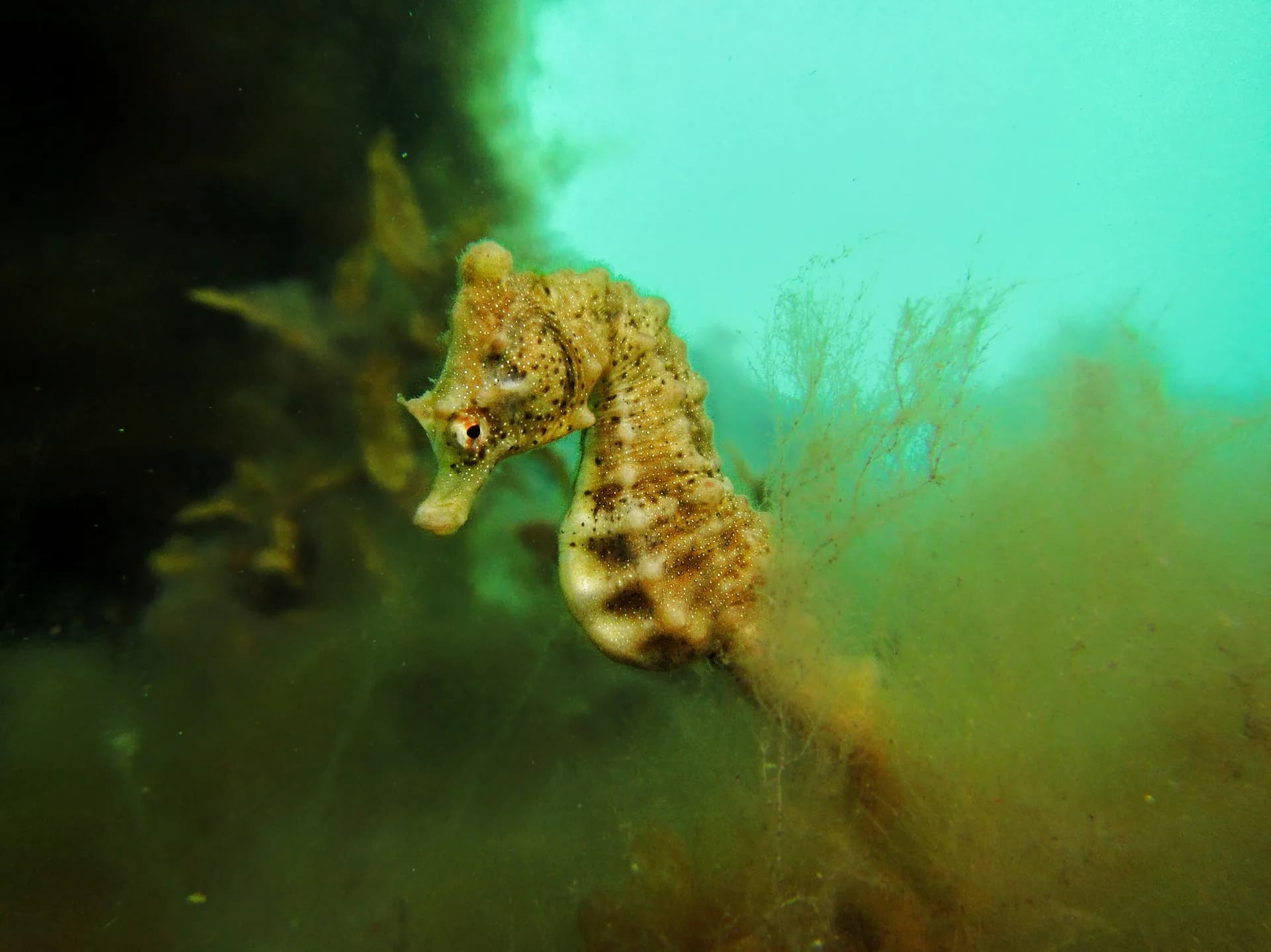
Short-snouted seahorses (Hippocampus breviceps) live among the seagrass beds and sponge gardens along the pier. They are small and superbly camouflaged — you need to look slowly and carefully. The eastern side of the pier, where seagrass beds are densest, is the best area to search. Once you spot your first one, you'll start seeing them everywhere.
Smooth Rays
Large smooth rays (Bathytoshia brevicaudata) are common at Rye Pier, resting on the sandy bottom beneath and around the pier. These gentle animals can have a wingspan exceeding 2 metres. They are docile and will often let you observe from close range if you approach slowly and calmly. Do not touch or stand on rays — their tail spine can cause a painful wound.
Cuttlefish
Giant Australian cuttlefish are present around the pier pylons, particularly in the cooler months. These remarkable animals can change colour and texture in an instant. At night they are more active and often display dramatic colour patterns when hunting.
Spider Crabs
During the annual spider crab migration (typically May-June), thousands of giant spider crabs congregate in the shallow waters around Rye Pier. The aggregation can be so dense that the seafloor appears to be moving. This is one of the most spectacular natural events in Port Phillip Bay, and Rye Pier is one of the best places to witness it.
Other Marine Life
- Schools of salmon and pike — Large schools of Australian salmon and pike regularly move through the pier area, especially in warmer months
- Nudibranchs — Dozens of species cling to pylons and sponges, from tiny to spectacular. Look closely at every surface
- Decorator crabs — These ingenious crabs cover themselves in sponge, algae, and debris for camouflage. Found on pylons and rocky substrate
- Pufferfish — Smooth toadfish and other pufferfish species are common residents, often resting in crevices or on the bottom
- Leatherjackets — Several species, including the six-spined leatherjacket, are abundant around the pylons
- Banjo sharks — Small, flat, and well-camouflaged on the sandy bottom
- Starfish and sea urchins — Common on pylons and along the seafloor
Blue-Ringed Octopus
Blue-ringed octopus are present at Rye Pier. They are small (12-20cm), usually well-camouflaged, and only display their bright blue rings when disturbed. Their bite carries a potentially fatal venom. Never pick up shells, rocks, or any octopus. If you spot one, observe from a safe distance and do not touch.
Why Rye Pier is Perfect for Beginners and Families
Rye Pier is widely considered Melbourne's most beginner-friendly and family-friendly dive site. Several factors combine to make it ideal for first-time snorkelers and families with children:
- Shallow depth — The entire pier sits in 2-5 metres of water. You can see the bottom from the surface at all times, which is reassuring for nervous snorkelers
- Sheltered water — Rye sits inside Port Phillip Bay, protected from ocean swells. On calm days the water is remarkably flat
- Easy entry — You can wade in from the beach at the base of the pier, avoiding the need to jump or climb down ladders
- Signposted trail — The Octopus Garden trail gives beginners a clear route and purpose. No guesswork, no getting lost, no wondering what to look for
- Abundant marine life — Even in shallow water close to shore, you'll see interesting creatures. There's no need to swim far or dive deep
- Family facilities nearby — Playground, toilets, cafes, and grassy foreshore areas are all within walking distance
If you're looking for a place to try snorkeling for the first time, or to introduce your children to the underwater world, Rye Pier is the place to start. For more pier options, see our full guide to the best snorkeling spots in Melbourne.
Freediving at Rye Pier
Rye Pier is an excellent site for freediving practice. The shallow depths (2-5 metres) make it ideal for beginner freedivers working on their breath-hold, duck dive technique, and equalisation. You can comfortably perform repeated dives to the bottom without the pressure demands of deeper sites.
For experienced freedivers, the value is in the marine life encounters rather than the depth. The shallow water means longer bottom times on each dive, which translates to more time photographing nudibranchs, watching octopus, or hovering near seahorses. The pylons create sheltered pockets of calm water, making it easy to maintain position and observe.
Rye Pier is also an excellent site for freediving students to complete their open water training dives. The calm conditions, shallow depth, and good visibility make it safe and comfortable for instructors and students alike.
If you're considering taking the step from snorkeling to freediving, see our guide to choosing a freediving course in Melbourne.
Night Diving and Night Snorkeling
Rye Pier at night is a completely different experience — and many divers consider it even better than a daytime visit. The pier's resident marine life transforms after dark, and species that hide during the day become active and visible.
An underwater torch is essential. Sweep it slowly along the pylons, across the sand, and through the seagrass. Here's what you'll find:
- Octopus — Emerge from their dens to hunt. You'll see far more octopus at night than during the day, often out in the open on the sand or stalking prey along the pylons
- Dumpling squid — These tiny, round squid (about the size of a golf ball) bury themselves in sand during the day and emerge to feed at night. Rye Pier is one of the most reliable spots to find them
- Cuttlefish — Active hunters at night, displaying dramatic colour changes as they stalk prey. Their eyes glow in torch light
- Smooth rays — Often more active at night, gliding silently across the sand
- Decorator crabs — Come out of hiding to feed on pylon surfaces
- Bioluminescence — On some nights, disturbing the water creates flashes of blue-green light from bioluminescent plankton
For night snorkeling, arrive before sunset to set up and enter the water while there's still some light. This lets you orient yourself along the pier before it gets dark. Always bring a backup torch, wear a bright dive float, and go with a buddy.
Spider Crab Migration at Rye
Each year, typically between May and June, thousands of giant spider crabs (Leptomithrax gaimardii) migrate into the shallow waters of Port Phillip Bay to moult their shells. Rye Pier is one of the premier locations to witness this event.
The crabs aggregate in enormous piles — sometimes several metres wide and stacked multiple layers deep. From the pier itself, you can often see the aggregation without even getting in the water. Beneath the surface, the sight is otherworldly — the seafloor appears to be a moving carpet of crabs, with thousands of animals moulting, feeding, and clambering over each other.
The migration is weather-dependent and can be unpredictable. The crabs tend to arrive after the water temperature drops below about 14°C. Local dive shops and community groups monitor the aggregation and post updates. For the full story, see our detailed guide to Melbourne's spider crab migration.
Seasonal Guide for Rye Pier
- Summer (Dec-Feb) — Warmest water (18-23°C), longest daylight hours. Schools of salmon and pike are most active. Busiest period for swimmers and boat traffic. Early morning or evening sessions avoid the crowds. Visibility is generally good at 4-8 metres
- Autumn (Mar-May) — Water still warm in March, cooling through autumn. Visibility often at its best. Fewer crowds. Spider crabs may begin arriving in late May. Cuttlefish become more active as water cools
- Winter (Jun-Aug) — Coldest water (10-13°C), requiring a 5mm wetsuit with hood and gloves. Spider crab migration peaks in June. Visibility can be excellent. Far fewer visitors — you may have the pier to yourself. Octopus and cuttlefish are active
- Spring (Sep-Nov) — Water gradually warming. Good all-round conditions. Marine life is active and visibility improves through the season. An excellent time for night dives as evenings are cool but not bitterly cold
Parking and Facilities
Rye township provides everything you need for a comfortable day at the pier:
- Parking — Free car park on the foreshore directly adjacent to the pier. Can fill up on warm summer weekends, so arrive early in peak season
- Toilets and showers — Public facilities on the foreshore near the pier
- Playground — A children's playground is located near the car park, perfect for keeping kids entertained before or after snorkeling
- Cafes and restaurants — Rye's main shopping strip is a short walk from the pier, with bakeries, fish and chip shops, cafes, and a supermarket
- Grassy foreshore — Plenty of space for picnics, setting up gear, and warming up after a dive
Tips for the Best Experience at Rye Pier
- Check the wind before you go — Northerly or north-easterly winds are ideal, keeping the water calm and visibility good. Southerly winds stir up the bay and reduce visibility significantly
- Snorkel the eastern side first — The sheltered side of the pier has calmer water and the Octopus Garden trail markers. Save the western side for a second pass if conditions allow
- Go slow — The best marine life at Rye is well-camouflaged. Move slowly along the pylons and scan every surface. Seahorses, nudibranchs, and decorator crabs reward patient observation
- Bring a torch even during the day — Many creatures hide in the shadows beneath the pier and inside crevices. A torch helps you spot octopus dens, nudibranchs, and other life that would otherwise be invisible
- Visit at high tide for the best snorkeling — At low tide, the water near shore can be extremely shallow. Higher water means you can comfortably snorkel the full length of the pier without scraping the bottom
- Try a night session — If you've only ever snorkeled during the day, a night visit to Rye Pier will change your perspective entirely. The marine life is dramatically different after dark
- Avoid post-rain sessions — Wait 48 hours after heavy rain. Stormwater runoff reduces visibility and water quality
Safety at Rye Pier
- Boat traffic — Rye Pier is an active boat launching area. Stay close to the pylons and be aware of boats approaching the pier, especially on weekends. A bright dive float makes you visible to boat operators
- Fishing lines — People fish from Rye Pier year-round. Be aware of fishing lines in the water, particularly near the end of the pier. Tangling in a fishing line underwater is a real hazard — carry a dive knife or line cutter
- Entry and exit — The easiest entry is wading in from the beach at the pier's base. Ladder access points along the pier provide alternatives. Be cautious on ladders — they can be slippery with algae growth
- Never snorkel or dive alone — Always go with a buddy, even at this shallow, sheltered site
- Don't touch marine life — Blue-ringed octopus are present. Smooth rays have a tail barb. Many sponges and hydroids can sting. The safest policy is to observe without touching anything
- Check conditions — Even inside the bay, strong winds can create choppy surface conditions. If the water looks rough from the pier, don't enter
Combine Rye Pier with Other Peninsula Sites
A full day on the Mornington Peninsula can include morning snorkeling at Rye Pier, lunch in the township, then an afternoon session at nearby Blairgowrie Pier or a drive to Flinders Pier. For a complete overview of all the Peninsula's dive sites, see our guide to diving the Mornington Peninsula.
Frequently Asked Questions
Is Rye Pier good for beginner snorkelers?
Rye Pier is one of the best beginner snorkeling sites in Victoria. The water is shallow (2-5 metres), sheltered from ocean swells, and the Octopus Garden underwater trail provides signposted markers so you always know where you are. You can wade in from the beach — no jumping or climbing required. Families with children regularly snorkel here, and the nearby playground and cafes make it a full family outing.
What is the Octopus Garden at Rye Pier?
The Octopus Garden is a signposted underwater exploration trail along Rye Pier. Numbered markers on the pier pylons guide snorkelers and divers along a route highlighting key marine life habitats — from sponge gardens and seahorse territory to octopus dens and ray resting areas. Information boards at the start of the pier explain the trail. It's a self-guided underwater nature walk, accessible to anyone who can put their face in the water.
Can you see octopus at Rye Pier?
Yes. Rye Pier is one of the most reliable spots in Melbourne to see octopus. They are present year-round, tucked into crevices between pylons or in dens on the sandy bottom. During the day, look for their middens — piles of discarded shells that mark the entrance to a den. At night, octopus are dramatically more active and visible, emerging to hunt across the sand and along the pylons. A night dive at Rye almost guarantees multiple octopus sightings.
When is the best time to snorkel at Rye Pier?
Rye Pier is excellent year-round. Summer (December to February) offers the warmest water at 18-23°C and the longest daylight hours. Autumn brings excellent visibility and fewer crowds. Winter features the spectacular spider crab migration in May-June — worth braving the cold water for. For night snorkeling, any calm evening works well in any season. Check wind conditions before you go — northerly winds are ideal, southerlies reduce visibility.