Mornington Pier Diving & Snorkeling Guide
A hidden gem in the heart of Mornington — seahorses, anglerfish, wobbegong sharks, and vibrant sponge gardens beneath a historic 1850s pier.
Last updated:
Mornington Pier doesn't announce itself like Flinders or Rye. It sits quietly in the centre of Mornington township, tucked into the inner harbour, heritage-listed and largely overlooked by the dive community. And that's exactly what makes it special.
While the more famous Mornington Peninsula piers draw weekend crowds, Mornington Pier remains a local secret — a sheltered, shallow site where seahorses cling to the sponge-covered pylons, anglerfish hide in plain sight, and wobbegong sharks rest beneath the timber structure. The water is rarely deeper than 10 metres. The conditions are forgiving. And the marine life, for those who take the time to look closely, is exceptional.
This is not a site for dramatic kelp forests or deep wreck penetration. Mornington Pier is a macro diver's playground — a place where patience is rewarded, where looking small reveals more than swimming fast, and where an hour underwater can yield a dozen species you've never seen before. It's also one of Melbourne's most convenient after-work dive sites, with easy parking, quick water access, and reliable shelter from southerly winds.
Location & History
Mornington Pier is located in the heart of Mornington township on the western shore of the Mornington Peninsula, approximately 60 kilometres south of Melbourne's CBD. The drive takes around 1 hour via the Mornington Peninsula Freeway, making it one of the closest Peninsula dive sites to the city.
The pier sits within Mornington Harbour, a protected inner bay formed by natural headlands and breakwaters. This inner harbour location is Mornington's defining feature as a dive site — it provides exceptional shelter from Port Phillip Bay's prevailing southerly winds, making it diveable on days when other Peninsula piers are blown out.
Mornington Pier has a long history. The original pier was constructed in the 1850s to service passenger steamers travelling between Melbourne and the Mornington Peninsula. The current structure dates from later reconstructions, but the pier retains its heritage status and continues to serve as both a working facility and a community landmark. The yacht squadron and marina adjacent to the pier add to the site's maritime character, though divers should be mindful of boat traffic.
Site Layout & Depth Profile
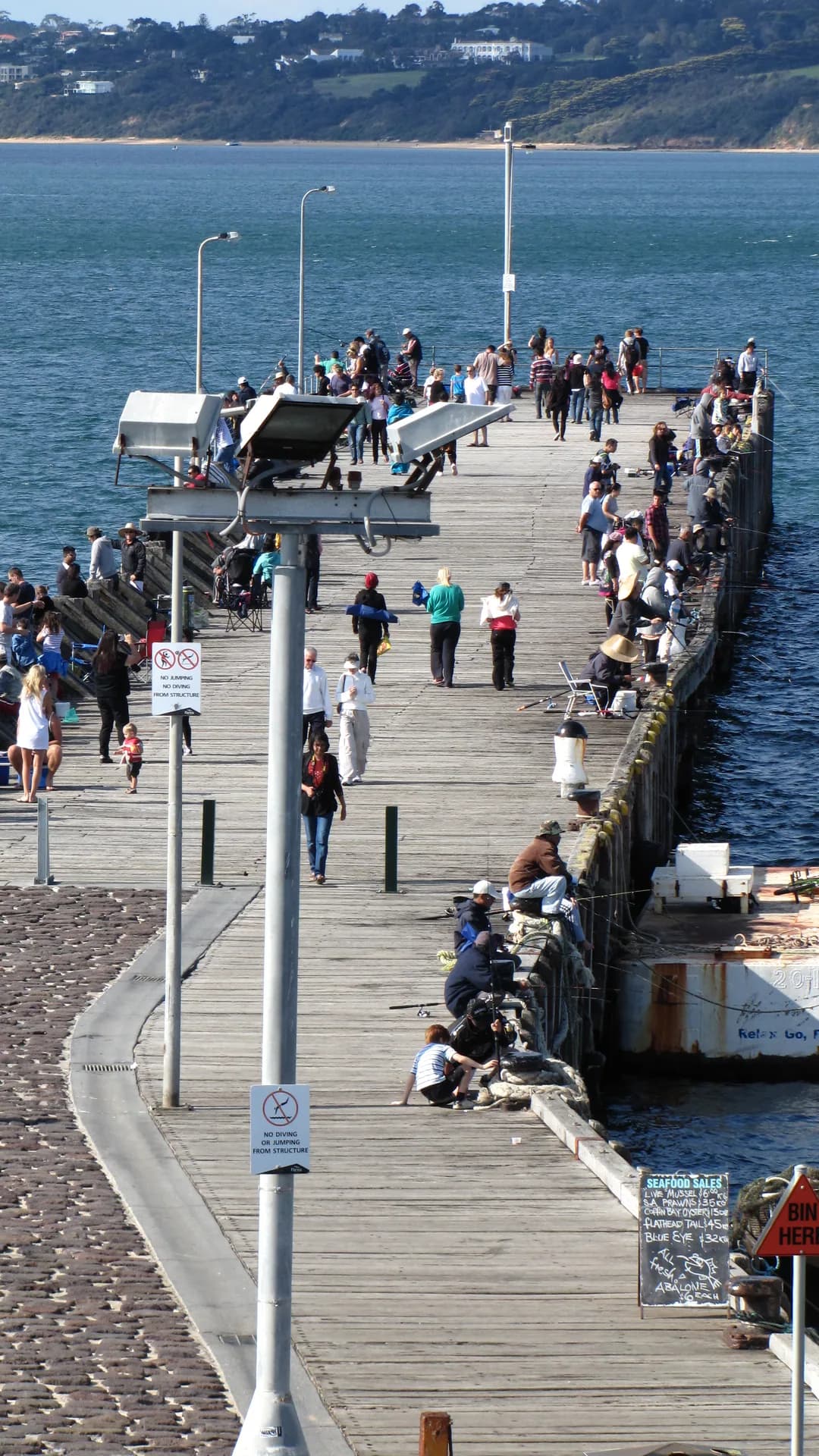
Mornington Pier extends from the Mornington foreshore into the inner harbour. The structure is timber-pylon construction, typical of Victoria's historic piers, with pylons spaced at regular intervals and connected by crossbeams. Below the waterline, these pylons are thickly encrusted with sponges, ascidians, and bryozoans — the foundation of the pier's marine ecosystem.
The site layout includes:
- Shore entry zone — Wading entry from the beach adjacent to the pier. Depths start at 0 metres and gradually increase as you move seaward. The bottom is sandy with patches of seagrass
- Inner pier section — The section closest to shore, typically 2-5 metres deep. This is the primary area for beginner snorkelers and families. Sponge coverage is moderate, and seahorses are often found in the seagrass and on lower pylon sections
- Outer pier section — Further out towards the end of the pier, depths increase to 6-10 metres depending on tide. This deeper zone has richer sponge coverage and is where anglerfish, wobbegong sharks, and larger nudibranchs are most commonly found
- Sandy bottom — A flat, sandy seabed between pylons and extending out from the pier. Home to rays, flathead, and decorator crabs. The sand is a good place to search for wobbegong sharks during the day
The maximum depth at the outer end of the pier is around 8-10 metres at high tide, though most of the interesting marine life is concentrated in the 3-7 metre zone where the sponge gardens are densest.
Marine Life
Mornington Pier's reputation as a hidden gem rests on its marine life diversity. The site won't give you the volume of fish you'd see at Flinders, but it consistently delivers unusual and cryptic species that many divers have never encountered elsewhere.
Seahorses
Short-snouted seahorses (Hippocampus breviceps) are resident at Mornington Pier and can be found year-round. They favour the seagrass patches near shore and the sponge-covered pylons in the 3-5 metre depth range. Seahorses are masters of camouflage — their colour and texture change to match their surroundings. Look slowly and carefully along pylon edges, rope lines, and seagrass fronds. Once you tune your eye to their shape, you'll start seeing them regularly.
Patient freedivers and snorkelers have the advantage here. A slow, deliberate approach and the ability to hover motionless at close range makes it easier to spot seahorses than the typical scuba diver passing through.
Anglerfish
Finding an anglerfish at Mornington Pier is one of the site's signature experiences. These bizarre, cryptic fish sit motionless on sponge-covered surfaces, perfectly camouflaged to blend with the texture and colour of their surroundings. They can be tiny — some species are only a few centimetres long — and they rely entirely on their disguise to avoid detection.
Anglerfish are ambush predators. They sit and wait for prey to approach, then strike with astonishing speed. For divers, the challenge is simply seeing them. Scan the sponge gardens on the pylons slowly. Look for texture changes, irregular shapes, or anything that looks slightly 'off'. Once you spot your first anglerfish, you'll never forget the shape.
Wobbegong Sharks
Wobbegong sharks are occasional visitors to Mornington Pier, though sightings are less frequent than at some other Peninsula sites. These carpet sharks rest on the sandy bottom beneath the pier during the day, their ornate, fringed skin providing near-perfect camouflage against sand and weed. They are harmless to humans unless provoked, but their camouflage is so effective that it's possible to swim within centimetres of one without realising it's there.
If you do encounter a wobbegong, observe from a respectful distance and avoid sudden movements. Never attempt to touch or handle any shark.
Nudibranchs
Mornington Pier hosts a rich diversity of nudibranch species. While it doesn't quite match Blairgowrie's reputation as the nudibranch capital, Mornington delivers consistent sightings across a wide range of species. The sponge-covered pylons are the primary habitat — look closely at every surface, especially in the 3-7 metre depth range.
Common species include the bright orange Ceratosoma brevicaudatum, delicate Chromodoris species with blue and white patterns, and various aeolid nudibranchs feeding on hydroids. Night dives often reveal species that hide during the day, including the spectacular Spanish dancer (Hexabranchus sanguineus).
Other Marine Life
- Octopus — Common residents, tucked into crevices and dens during the day. Night dives reveal them hunting actively across the sand and pylons
- Blue-ringed octopus — Present at Mornington as at most bay sites. Small, well-camouflaged, and potentially lethal if handled. Observe from a distance and never touch
- Rays — Smooth rays rest on the sandy bottom between pylons. Large individuals can have wingspans exceeding 1.5 metres. They are docile but their tail barb is a hazard — never step on or touch a ray
- Cuttlefish — Active in the cooler months, often seen around the pylons. Their colour-changing ability is mesmerising to watch
- Globefish and pufferfish — Several species of toadfish and pufferfish are common, often resting in crevices or on the sand
- Leatherjackets — Abundant around the pylons. Six-spined leatherjackets, with their distinctive dorsal spine, are particularly common
- Decorator crabs — Masters of disguise, covering themselves with sponge and algae fragments. Finding one is always satisfying
- Sponges and ascidians — The living architecture of Mornington Pier. Vibrant reds, oranges, purples, and yellows coat the pylons from waterline to bottom, creating one of the bay's most colourful underwater environments
Blue-Ringed Octopus Warning
Blue-ringed octopus are present at Mornington Pier. They are small, cryptic, and only display their warning colours when threatened. Their venom is potentially fatal and there is no antivenom. Never pick up shells, rocks, or any octopus. If you see one, observe from a safe distance and do not approach closely. Educate children about the danger before entering the water.
Freediving at Mornington Pier
Mornington Pier is an excellent freediving site for all skill levels. The shallow depth profile (3-10 metres) means that even beginner freedivers can explore the entire site comfortably, while the rich marine life rewards the slow, deliberate approach that freediving encourages.
The best freediving strategy at Mornington is to focus on the pylons. Drop down to a pylon in the 3-7 metre depth range, scan the sponge gardens at eye level for 30-60 seconds, then surface and move to the next pylon. This methodical approach allows you to cover more ground than scuba divers while spending meaningful time observing each micro-habitat.
Seahorses, anglerfish, and nudibranchs require stillness to photograph effectively. Freedivers have the advantage of being able to descend, stabilise neutrally buoyant at the target depth, and hold perfectly still for the duration of their breath-hold. This makes freediving particularly effective for macro photography at Mornington Pier.
The shallow depths also make Mornington an ideal site for freediving training. Students can comfortably practice duck dives, equalisation, finning technique, and breath-hold without the pressure or narcosis concerns of deeper sites. The calm conditions inside the harbour provide a forgiving environment for building confidence.
For those new to freediving, see our guide to the best freediving spots in Melbourne for a full overview of sites graded by difficulty.
Snorkeling at Mornington Pier
Mornington Pier is an outstanding snorkeling site, particularly for families and beginners. The inner harbour location means sheltered, calm water on most days, and the shallow depths (2-5 metres near shore) allow snorkelers to see the bottom clearly and comfortably.
The best snorkeling zone is the inner section of the pier, close to shore. Here, depths range from 2-5 metres, visibility is generally good, and the marine life is abundant. Seahorses can be found in the seagrass patches and on the lower sections of the pylons. Nudibranchs cling to the sponge-covered surfaces. Schools of fish move between the pylons, and rays rest on the sandy bottom.
Entry is easy — simply wade in from the beach adjacent to the pier. The gradual depth increase makes it comfortable for nervous snorkelers and children. There's no need to swim far from shore to see interesting marine life — the richest habitats are often within 20-30 metres of the beach entry point.
For the best snorkeling experience at Mornington Pier:
- Snorkel at high tide when water depths are greatest and entry is easiest
- Bring an underwater torch even during the day to peer into shadowed areas beneath the pier where octopus and anglerfish hide
- Move slowly along the pylons rather than swimming quickly between them. The best finds reward patience
- Visit on a calm day with light winds from the north or north-east for the clearest water
For a broader overview of Peninsula snorkeling sites, see our complete guide to the best snorkeling spots in Melbourne.
Night Diving
Mornington Pier is one of Melbourne's most popular after-work night dive sites. The combination of easy access, sheltered conditions, and proximity to the city (only 1 hour from the CBD) makes it ideal for evening sessions year-round.
The marine life transforms after dark. Octopus emerge from their dens to hunt, moving boldly across the sand and pylons. Cuttlefish display dramatic colour changes as they stalk prey. Decorator crabs come out of hiding to forage on the sponge-covered surfaces. Rays glide silently across the sand, their wingbeats illuminated in your torchlight.
Cryptic species that are nearly impossible to find during the day become visible at night. Dumpling squid emerge from the sand. Bobtail squid hover in the open water. Nocturnal nudibranchs appear on surfaces that looked barren during daylight hours.
A quality underwater torch is essential. A focused beam is more effective than a wide flood for spotting small creatures against the sponge-covered pylons and sandy bottom. Many divers carry a primary torch for general lighting and a smaller backup torch for safety.
Night Diving Safety at Mornington
Mornington Harbour has active boat traffic, and vessels may be moving after dark. Always carry a torch, use a dive float with a light, and avoid surfacing in boat channels. Never night dive alone — a buddy is essential. Entry and exit from the pier can be disorienting at night, so familiarise yourself with the layout during daylight hours before attempting a night dive.
For comprehensive night diving guidance including gear, techniques, and other sites, see our complete guide to night diving in Melbourne.
Best Conditions
Mornington Pier can be dived year-round, but conditions vary with weather, tide, and season.
- Wind — The inner harbour location provides excellent shelter from southerly winds, which is Mornington's defining advantage. On days when Blairgowrie, Rye, and other exposed Peninsula piers are blown out, Mornington often remains calm and diveable. North and north-east winds are ideal, but even moderate southerlies are manageable here
- Visibility — Ranges from 2-3 metres on poor days to 6-10 metres on excellent days. Autumn and winter tend to produce the clearest water. Avoid diving within 48 hours of heavy rain, as stormwater runoff from the township reduces water quality and visibility
- Tide — High tide provides the deepest water and easiest entry from the beach. Low tide exposes more of the pier pylons and can make the near-shore zone very shallow. Slack water (the period around high or low tide) generally offers the calmest conditions with minimal current
- Season — Summer (December-February) brings the warmest water at 18-23°C, though visibility can be variable. Autumn (March-May) often delivers the best combination of good visibility, comfortable water temperature, and fewer crowds. Winter (June-August) is cold (10-13°C) but often produces excellent clarity and memorable marine life encounters. Spring (September-November) sees gradually warming water and improving conditions
Parking & Facilities
Mornington Pier sits in the heart of Mornington township, which means excellent facilities are within easy walking distance.
- Parking — Public car parks are available along the Mornington foreshore and Esplanade. Parking is free in some areas and paid in others, with prices and time limits varying by season. Arrive early on summer weekends to secure a space close to the pier
- Toilets and showers — Public facilities are located on the foreshore near the pier
- Cafes and restaurants — Mornington's Main Street is a short walk from the pier, with dozens of cafes, bakeries, restaurants, and fish-and-chip shops. Perfect for post-dive meals or coffee
- Dive shops — Several dive shops operate on the Mornington Peninsula, offering gear hire, air fills, and local knowledge
- Grassy foreshore — Open grassy areas along the foreshore provide space for gear setup, picnics, and post-dive relaxation
Nearby Dive Sites
Mornington Pier sits on the western end of the Mornington Peninsula's dive trail. If you're making the drive from Melbourne, it's worth planning a day that includes more than one site.
- Schnapper Point — 5 minutes south along the Mornington foreshore. A shore dive with kelp, reef structures, and deeper water than the pier. Good for more experienced divers
- Rye Pier — 25 minutes east along Point Nepean Road. The Octopus Garden trail, excellent beginner snorkeling, and reliably good visibility. See our complete guide to Rye Pier
- Blairgowrie Pier — 30 minutes east. Melbourne's nudibranch capital, with over 100 species recorded. A macro photographer's dream. See our Blairgowrie Pier guide
- Flinders Pier — 50 minutes south-east. The premier pier dive in Victoria, with weedy seadragons, sponge gardens, and the richest fish life of any Peninsula site
For a comprehensive overview of all the Mornington Peninsula dive sites, conditions, and how to combine them into a full day of diving, see our complete guide to diving the Mornington Peninsula.
Frequently Asked Questions
Is Mornington Pier good for diving?
Yes, Mornington Pier is an excellent sheltered dive site with diverse marine life including seahorses, anglerfish, and wobbegong sharks. Depths of 0-10 metres suit all skill levels from beginners to experienced divers. The inner harbour location provides consistent protection from wind and swell, making it diveable on days when more exposed Peninsula piers are blown out. It's particularly valued as a reliable after-work dive site due to its proximity to Melbourne.
What can you see diving at Mornington Pier?
Seahorses, anglerfish, wobbegong sharks, nudibranchs, blue-ringed octopus, rays, cuttlefish, and abundant fish life on sponge-covered pylons. The pier's sponge gardens are particularly vibrant, coating the pylons in reds, oranges, and purples. Patient observers often find rare and cryptic species including the bizarre anglerfish and well-camouflaged wobbegong sharks resting beneath the structure. Night dives reveal octopus, dumpling squid, and decorator crabs.
Is Mornington Pier good for night diving?
Yes, Mornington Pier is a very popular after-work night dive spot due to its easy access, sheltered conditions, and proximity to Melbourne (only 1 hour from the CBD). Octopus emerge from their dens to hunt after dark. Cuttlefish display dramatic colour changes as they stalk prey. Decorator crabs and dumpling squid become visible. The shallow depths mean comfortable, relaxed night sessions, and the inner harbour location provides shelter even on breezy evenings.
How deep is Mornington Pier?
Depths at Mornington Pier range from 0 metres at the shore entry to about 8-10 metres at the outer end of the pier. Most diving activity happens in the 3-7 metre depth range where the sponge coverage is richest and marine life most concentrated. The shallow profile makes it accessible to snorkelers, beginner freedivers, and scuba divers alike. High tide adds roughly 1-2 metres to these depths.