Pope's Eye Diving & Snorkeling Guide
Victoria's first marine reserve — an uncompleted 1880s fort turned wildlife sanctuary, where fur seals, gannets, and kelp forests thrive in the waters of Port Phillip Bay.
Last updated:
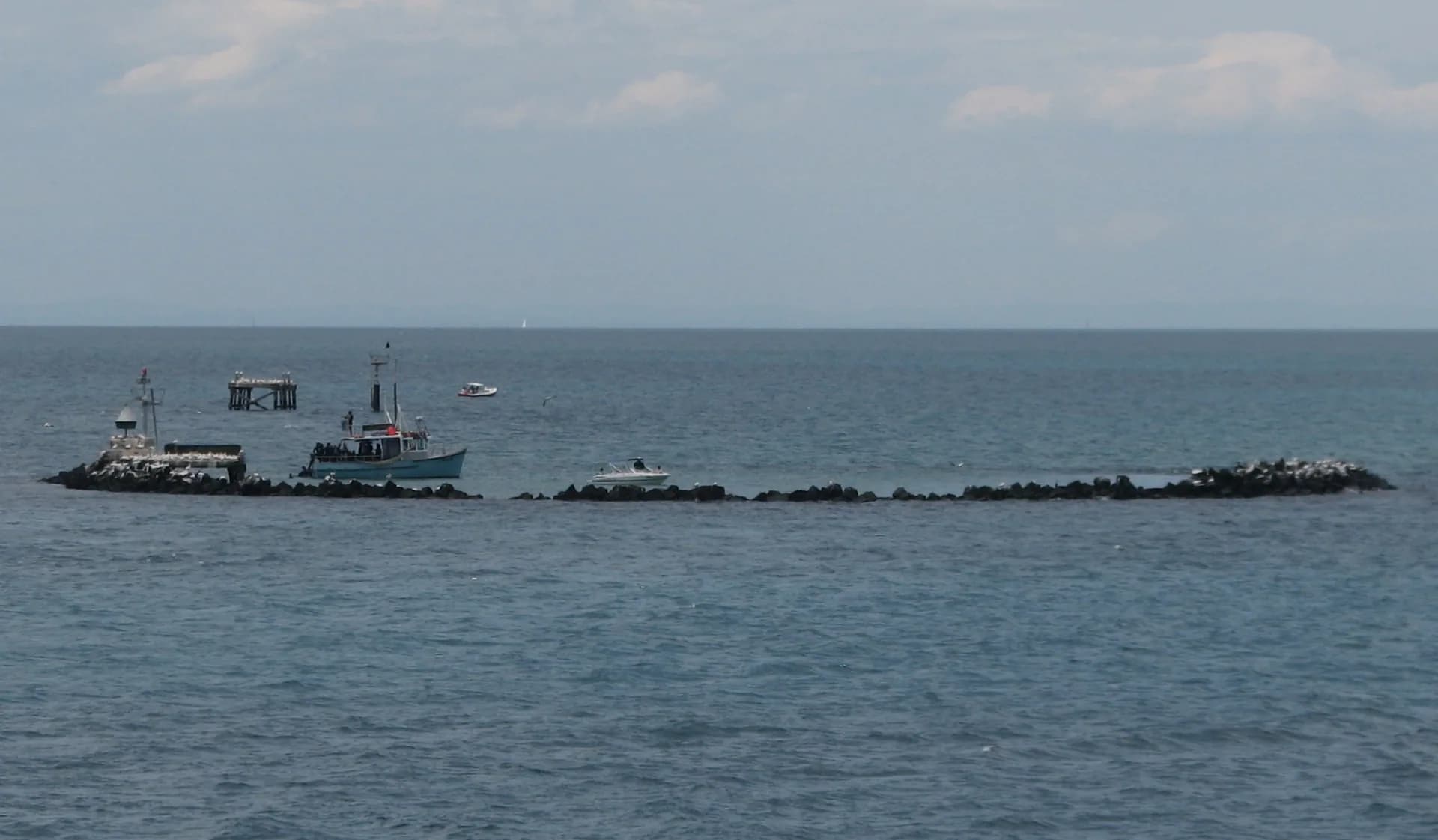
Pope's Eye is one of the most unusual and fascinating dive sites in Victoria. It is an artificial island — a ring of massive bluestone blocks sitting in Port Phillip Bay near the entrance to the bay at the Heads. Originally constructed in the 1880s as a fortification that was never completed, it has since become Victoria's first marine reserve and a thriving wildlife sanctuary. Above the water, Australian fur seals haul out on the rocks and Australasian gannets nest on the structure. Below the surface, kelp forests wrap around the stone walls, fish swirl in dense schools, and sponge gardens coat every crevice.
Pope's Eye is boat-access only — there is no way to reach it from shore — and it sits in an exposed location near the Port Phillip Heads, which makes conditions highly weather-dependent. But when conditions align, it is an extraordinary dive. The combination of history, wildlife, and marine life in one compact location is unmatched anywhere else in Melbourne.
This guide covers everything you need to know to plan your visit: the history of the structure, its status as a marine reserve, how to get there, what you will find underwater, tips for freediving and snorkeling, safety considerations, and which tour operators run trips to the site.
History
Pope's Eye was never meant to be a dive site. It was meant to be a fort — part of a defensive network protecting Port Phillip Bay from feared Russian invasion during the 1880s. The plan was to build a fortified island at the entrance to the bay, armed with heavy artillery that could fire on any enemy ships attempting to enter. Work began in 1887. Hundreds of tonnes of bluestone blocks were barged out from Williamstown and sunk in place to form a ring-shaped foundation. Over the following years, workers continued to add rock and build up the structure, intending to eventually cap it with concrete and mount guns on top.
The fort was never finished. By the early 1890s, the perceived Russian threat had faded, funding dried up, and the project was abandoned. What remained was a horseshoe of massive stone blocks rising a few metres above the waterline — a strange, isolated structure in the middle of the bay.
For decades, Pope's Eye sat unused. Fishermen occasionally stopped at the rocks. Seabirds began to roost on the structure. And then, gradually, it became something else entirely: a magnet for marine life. The rock walls provided hard substrate in an area that is mostly sand and mud. Kelp attached. Sponges colonised the stone. Fish moved in. Australian fur seals, expanding their range after protection from hunting in the mid-20th century, began hauling out on the rocks. By the 1970s, Pope's Eye was recognised as having significant ecological value — it was officially declared Victoria's first marine reserve in 1979.
Today, Pope's Eye is managed by Parks Victoria as a no-take marine protected area. The history is still visible — you can see the neatly cut bluestone blocks stacked in rows, the original engineering of the fort foundation still intact — but nature has entirely reclaimed the structure. It is a rare case where a piece of abandoned military infrastructure has become a thriving sanctuary.
Marine Reserve Status
Pope's Eye Marine Reserve was declared in 1979, making it Victoria's first marine reserve. This status provides the highest level of protection for the marine environment within Victorian waters. Within the reserve boundaries, all extraction is prohibited — no fishing, no spearfishing, no collecting of shells, rocks, or marine life of any kind. The goal is to preserve the ecosystem in as close to a natural state as possible, allowing species to thrive without human harvesting pressure.
The reserve extends in a radius around the Pope's Eye structure. Specific boundaries are marked on marine charts and are enforced by Parks Victoria and Fisheries officers. Penalties for breaching the no-take regulations are significant, and the reserve is regularly patrolled.
What does this mean for divers? It means the marine life at Pope's Eye is notably more abundant and less wary than at unprotected sites. Fish that are heavily targeted elsewhere — such as snapper and flathead — can grow larger here. The reserve status also protects the structural integrity of the site itself: removing rocks, disturbing the seabed, or damaging the bluestone blocks is prohibited.
You are welcome to dive, snorkel, and swim in the reserve. Photography is encouraged. But nothing can be taken, and nothing can be disturbed. The principle is simple: leave only bubbles, take only photos.
Getting There
Pope's Eye is located approximately 7 kilometres offshore from Queenscliff, near the entrance to Port Phillip Bay at the Heads. It is boat-access only — there is no shore entry and no way to reach it by kayak or paddleboard safely. The waters around the Heads are some of the most hydrodynamically active in Victoria, with powerful tidal currents sweeping through the narrow gap between the bay and Bass Strait. This makes Pope's Eye accessible only by motorised boat.
For most visitors, the practical way to reach Pope's Eye is via a guided tour. Several operators run regular trips from Queenscliff and Sorrento, typically combining Pope's Eye with a visit to Chinaman's Hat (a nearby seal colony) or dolphin swimming in the southern bay. These tours are well-equipped, know the site thoroughly, and only operate when conditions are suitable.
If you have access to your own boat, Pope's Eye is navigable for experienced skippers who understand the Heads area. However, you need to respect the tidal flows, be aware of the strong currents around the structure, and monitor the weather closely. Conditions can change rapidly. The site is marked on marine charts, and GPS coordinates are widely available, but local knowledge is invaluable — this is not a beginner boating area.
Typical travel times by boat:
- From Queenscliff: 30-40 minutes
- From Sorrento: 40-50 minutes
The journey crosses open water and can be choppy, particularly when there is swell or strong wind. If you are prone to seasickness, take precautions before departure.
Site Layout
Pope's Eye is a horseshoe-shaped structure, roughly 90 metres across at its widest point. The open end of the horseshoe faces roughly north-east, toward the bay. The outer walls are built from massive cut bluestone blocks, each weighing several tonnes, stacked to form a rampart that rises 2-3 metres above mean sea level. In rough conditions, waves crash over the top of the rocks, but on calm days, the structure is stable and seals lounge on the sun-warmed stone.
The interior of the horseshoe forms a sheltered basin — a natural lagoon protected from the open water. This inner basin is where most snorkeling and diving activity takes place. The water inside is calmer than the surrounding sea, the depth is shallow (2-3 metres in most areas), and the concentration of marine life is high. The walls of the structure drop vertically from the waterline down to the sandy bottom, creating interesting vertical habitat.
The outer walls of the structure are more exposed and drop into deeper water. Depending on the side of the structure, depths range from 6 to 14 metres on the outer edges. These outer sections are only diveable in calm conditions due to surge and current, but they support different marine communities — larger kelp, deeper-water fish species, and more pronounced sponge growth.
The structure itself is solid and stable. The bluestone blocks are tightly fitted and have been in place for over 130 years. Erosion is minimal, though some blocks on the outer edges have shifted slightly over the decades. The inside basin floor is sandy with patches of low reef and scattered rubble.
Depth Profile
- Inner basin: 2-3m — ideal for snorkeling and beginner freediving
- Top of the walls: 0-1m (exposed at low tide)
- Base of inner walls: 2-4m
- Outer walls (sheltered side): 6-10m
- Outer walls (exposed side): 10-14m
- Surrounding seabed: 8-12m
The shallow inner basin makes Pope's Eye accessible to snorkelers and beginner freedivers, while the deeper outer walls provide more challenging diving for those comfortable at depth. The site offers something for all skill levels.
Marine Life
Pope's Eye punches well above its weight in terms of marine biodiversity. The structure acts as an artificial reef in an area that would otherwise be barren sand, and the marine reserve status has allowed populations to flourish. Here is what you can expect to find.
Australian Fur Seals
A resident colony of 20-30 Australian fur seals lives at Pope's Eye year-round, hauling out on the bluestone blocks to rest, sun themselves, and socialise. These seals are famously playful and curious, particularly the juveniles. In the water, they are fast, graceful, and highly interactive. It is not unusual for a young seal to approach snorkelers and divers, circling around them, blowing bubbles, and investigating masks and fins with genuine curiosity.
The seals hunt in the waters around the structure and return to the rocks to rest. They are completely habituated to boats and swimmers — Pope's Eye is one of the most reliable sites in Victoria for seal encounters. For more on swimming with seals, see our complete guide to swimming with seals and dolphins in Melbourne.
Australasian Gannets
Pope's Eye is one of only a handful of sites in Victoria where Australasian gannets nest. These large, striking seabirds — brilliant white with golden heads and black-tipped wings — nest on the exposed rock platforms during the breeding season (roughly October to February). At any given time, you may see dozens of gannets perched on the rocks, with others wheeling overhead or plunge-diving into the water around the structure to catch fish.
Watching gannets plunge-dive from the surface while snorkeling is extraordinary. They hit the water at high speed, wings folded, and arrow down several metres before turning and pursuing fish underwater. If you are in the water when a gannet dives nearby, you will hear the impact and see the explosive entry. It is one of the most dramatic wildlife behaviours you can witness in Victorian waters.
Kelp Forests
The outer walls of Pope's Eye support dense kelp growth, particularly on the more sheltered sides. Both bull kelp (Durvillaea) and crayweed (Phyllospora comosa) attach to the bluestone, their fronds swaying in the surge. These kelp forests provide habitat for fish, invertebrates, and smaller algae species. The sight of golden-brown kelp fronds streaming in the current, backlit by sunlight, is one of the defining visuals of diving at Pope's Eye.
Fish Concentrations
The structure acts as a fish aggregation device. Schools of old wives, leatherjackets, and sweep cluster around the walls. Snapper, some of significant size, patrol the perimeter — a direct result of the no-take marine reserve protection. Flathead lie on the sandy bottom of the inner basin. Wrasse dart in and out of the kelp. Moonlighters and morwong hover near the deeper sections of the outer walls.
The fish at Pope's Eye are noticeably less skittish than at non-protected sites. They are accustomed to divers and allow closer approach, making photography easier and encounters more rewarding.
Sponge Gardens
The bluestone blocks are covered in colourful sponge growth — orange, yellow, purple, and red sponges encrust the submerged sections of the walls, particularly on the outer faces where current brings nutrient-rich water. These sponge gardens support a secondary layer of biodiversity: nudibranchs graze on the sponges, small crustaceans hide in the crevices, and fish pick at the invertebrate life.
Other Species
Expect to see Port Jackson sharks resting on the sand, smooth rays gliding over the bottom, cuttlefish hovering near the walls, and occasional octopus tucked into the gaps between blocks. During the spider crab migration season (May-July), aggregations of spider crabs sometimes pass through the area, though the main migration routes are elsewhere in the bay.
Freediving at Pope's Eye
Pope's Eye is an excellent site for freediving, particularly in the inner basin. The shallow depth (2-3 metres) means even beginner freedivers can comfortably reach the bottom and spend extended time observing the marine life. The sheltered conditions inside the horseshoe make it easier to relax, control your breathing, and focus on what is happening underwater rather than fighting surge or current.
The seals are the main attraction for freedivers. Australian fur seals respond far more positively to freedivers than to scuba divers — the lack of bubbles and the ability to move fluidly underwater makes freedivers more interesting to the seals. Juveniles in particular will approach and interact, often mimicking your movements. If you duck-dive to the bottom and look up at them, they will frequently follow you down, spiralling around you and blowing bubbles. The more playful and relaxed you are, the longer they will stay.
For freediving the outer walls, you need more experience and comfort with depth. The outer sections drop to 10-14 metres, and there can be current and surge to manage. But if you have the skills, the outer walls offer spectacular vertical freediving — descending along the kelp-covered bluestone, finning along the wall at depth, and ascending back up through the kelp forest.
Freediving Tip
When diving with seals at Pope's Eye, try duck-diving to the sandy bottom of the inner basin and looking up. The young seals are incredibly curious and will often swim directly to you, circling around and blowing bubbles. Avoid chasing or reaching for them — let them come to you. The more still and relaxed you are, the more interactive they become.
For a broader overview of the best freediving sites in Melbourne, see our guide to Melbourne's best freediving spots.
Snorkeling
The inner basin at Pope's Eye is ideal for snorkeling. The depth is shallow (2-3 metres), the water is sheltered, and you can see the entire ecosystem from the surface with a mask and snorkel. The visibility inside the basin is typically better than in the surrounding open water, and the concentration of fish makes it visually engaging even if you never dive below the surface.
Most guided tours position snorkelers in the inner basin, where conditions are calm and safe. From the surface, you can watch seals swimming below you, fish schooling around the walls, and gannet plunge-diving nearby. If you have a weight belt (even just 2-3 kg), you can duck-dive briefly to get a closer look at the sponge-covered walls and the sandy bottom without needing full freediving skills.
Snorkeling at Pope's Eye is suitable for beginners, provided conditions are calm and you are part of a guided tour with appropriate supervision. The sheltered inner basin removes much of the challenge, and the marine life is abundant enough that even a short 20-minute snorkel is rewarding.
For more snorkeling sites around Melbourne, see our guide to Melbourne's best snorkeling spots.
Safety
Pope's Eye sits in one of the most dynamic and potentially hazardous stretches of water in Victoria — the Port Phillip Heads. Safety considerations are critical.
Currents
The Heads area experiences powerful tidal currents as billions of litres of water flow in and out of Port Phillip Bay twice a day. These currents can exceed several knots, and they are strongest during spring tides (around the new and full moon). The currents around Pope's Eye can be significant, particularly on the outside of the structure.
The inner basin is generally sheltered from the worst of the current, but even inside the horseshoe you need to be aware of water movement. If you feel yourself being pulled by current, stay close to the structure or signal your boat. Never fight a strong current — conserve your energy and get assistance.
Guided tours are timed around tidal flows to ensure safe diving conditions. If you are visiting independently, you must check tide charts and plan your dive for slack water (the period of minimal current between tidal changes).
Boat Traffic
Pope's Eye sits near the main shipping channel for Port Phillip Bay. Large commercial vessels, ferries, and recreational boats pass through the area regularly. When diving or snorkeling at Pope's Eye, always use a surface marker buoy (SMB) or dive float to make yourself visible to passing boats. Never assume that a boat has seen you — stay alert and stay close to your group.
Weather Exposure
Pope's Eye is exposed to weather from Bass Strait. Strong winds — particularly south-westerly and southerly winds — can make conditions rough very quickly. What looks calm in the bay can be significantly rougher at the Heads. Always check the marine forecast before a trip, and trust your tour operator if they cancel due to weather. This site is only diveable in good conditions.
Seal Interactions
While the seals at Pope's Eye are famously friendly, they are still wild animals and should be treated with respect. Juvenile seals are playful and interactive, but adult bulls can be territorial and should be given wide berth. If a large seal postures, barks, or moves toward you aggressively, calmly back away. Never corner a seal, never touch them, and never attempt to ride or grab them. Most seal interactions at Pope's Eye are gentle and joyful, but respect their space.
Under Victorian wildlife regulations, you must not approach seals closer than 5 metres. However, the seals are free to approach you — and they frequently do. If a seal swims up to you, that is fine. The rule prevents you from chasing or cornering animals, not from allowing them to interact on their terms.
Safety Reminder
Pope's Eye is located in an area with strong tidal currents, significant boat traffic, and exposure to open-ocean conditions. Only dive this site in calm weather, always use a surface marker buoy, and stay within the inner basin unless you have advanced skills and local knowledge. Guided tours are strongly recommended for first-time visitors.
Buddy System
Never dive or snorkel at Pope's Eye alone. Always dive with a buddy who understands freediving safety protocols. In an emergency, the remoteness of the site and the challenging conditions mean that self-rescue may not be possible. A competent buddy is essential.
Tour Operators
Several operators run trips to Pope's Eye, typically as part of broader seal and dolphin swim tours. These tours are well-established, professionally run, and are the safest and most practical way to visit the site for most people.
Sea All Dolphin Swims
Based in Sorrento, Sea All runs regular dolphin and seal swim tours that include Pope's Eye and Chinaman's Hat. Tours typically depart early in the morning and last 3-4 hours. Equipment (wetsuit, mask, snorkel, fins) is provided. Sea All has been operating in the area for years and has deep local knowledge of conditions and wildlife.
Moonraker Dolphin Swims
Also based in Sorrento, Moonraker offers similar seal and dolphin swim experiences, with visits to Pope's Eye included in most itineraries. Moonraker is known for their experienced crew and commitment to sustainable wildlife tourism. They operate year-round, weather permitting, with the best season from November to April.
Polperro Dolphin Swims
Another established Sorrento operator, Polperro runs guided marine wildlife tours including seal swims at Pope's Eye. Their tours focus on education and conservation, and they are licensed by Parks Victoria to operate in the marine reserve.
Queenscliff Operators
Some operators also run trips from Queenscliff, which is slightly closer to Pope's Eye than Sorrento. These trips are shorter in transit time but may focus more on Pope's Eye and Chinaman's Hat rather than including dolphin swimming. Check local listings for current operators and availability.
What to Expect from a Tour
- Cost: Typically $150-200 per person
- Duration: 3-4 hours total
- Inclusions: Boat transport, wetsuit, mask, snorkel, fins, and guide
- Bookings: Advance booking is essential, especially during summer
- Conditions: Tours are weather-dependent and may be cancelled or rescheduled if conditions are unsuitable
Most tours combine Pope's Eye with Chinaman's Hat and occasionally dolphin swimming, providing a full day of marine wildlife encounters. Tours depart early (often around 7-8am) to catch the best conditions and animal activity.
Frequently Asked Questions
How do you get to Pope's Eye?
Boat only. Tours depart from Queenscliff and Sorrento, typically 30-45 minutes each way. Operators include Sea All Dolphin Swims, Moonraker Dolphin Swims, and Polperro Dolphin Swims. The site is not accessible from shore, and the conditions around the Heads make it unsuitable for kayaks or paddleboards.
Can you snorkel at Pope's Eye?
Yes, the inner basin is 2-3 metres deep and sheltered, making it excellent for snorkeling. You will see fish, kelp-covered walls, sandy bottom, and potentially seals swimming around you. Most guided tours position snorkelers in the inner basin where conditions are safest and visibility is best.
Are there seals at Pope's Eye?
Yes, a resident colony of 20-30 Australian fur seals lives on the rocks at Pope's Eye. They regularly swim with snorkelers and divers in the inner basin, often approaching very closely. Juvenile seals are particularly curious and playful, making Pope's Eye one of the most reliable sites in Victoria for interactive seal encounters.
What is Pope's Eye?
Pope's Eye is a partially built stone fort from the 1880s in Port Phillip Bay, now Victoria's first marine reserve (declared in 1979). The horseshoe-shaped structure was originally intended to defend the bay from invasion but was never completed. Today, it is a thriving marine sanctuary with abundant fish, kelp forests, resident seals, and nesting seabirds.