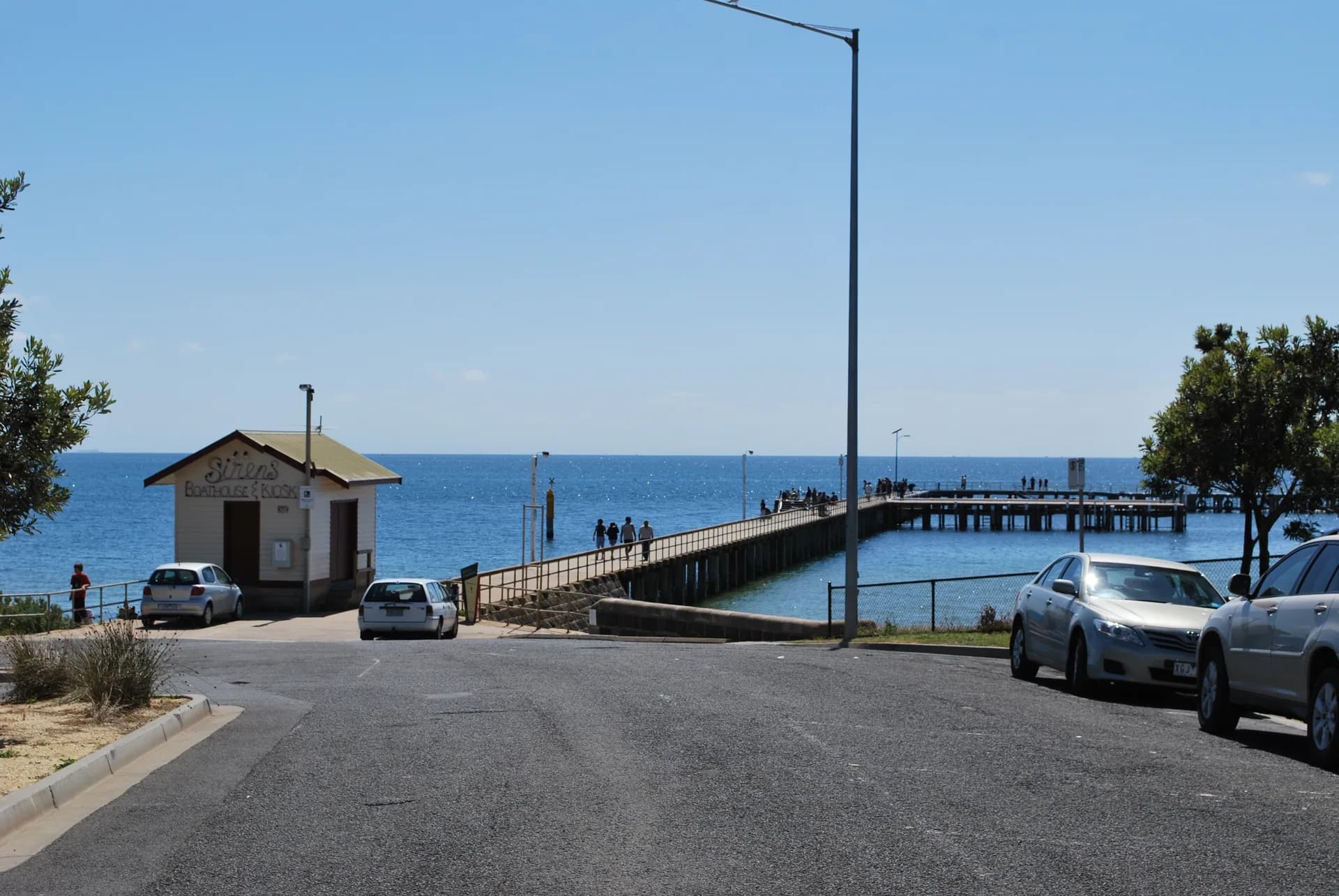
St Leonards Pier Diving & Snorkeling Guide
A hidden gem on the Bellarine Peninsula — an F-shaped pier offering exceptional macro photography, seahorses, nudibranchs, and some of Victoria's best night diving in sheltered, accessible water.
Last updated:
St Leonards Pier doesn't get the attention that Blairgowrie, Rye, or Flinders do. And that's precisely what makes it special.
Tucked into the western shore of Port Phillip Bay on the Bellarine Peninsula, St Leonards is a compact, F-shaped timber pier that punches well above its weight for marine diversity. This is a macro site first and foremost — a place where seahorses cling to pylons, nudibranchs graze on sponge gardens, and stargazers bury themselves in the sand. The unique F-shaped layout offers sheltered diving on almost any wind direction, the shallow 4-6 metre depth makes it accessible to snorkelers, freedivers, and scuba divers alike, and the night diving here is genuinely world-class.
St Leonards rewards patience, close observation, and a macro lens. It's not a site for big pelagics or dramatic kelp forests. It's a site for slowing down, looking closely, and discovering a miniature world that most divers overlook. If you like the hunting aspect of diving — the search for cryptic life that tests your eye — you'll love St Leonards.
Location
St Leonards Pier is located on the Bellarine Peninsula, approximately 90 minutes from Melbourne's CBD via the Princes Freeway and Bellarine Highway. The pier sits on the foreshore of St Leonards, a small coastal village on the western side of Port Phillip Bay, between Queenscliff to the south and Portarlington to the north.
From Melbourne, take the Princes Freeway through Geelong, then follow the Bellarine Highway east towards Queenscliff. Turn left onto St Leonards Road to reach the foreshore and pier. The drive is straightforward, and St Leonards is quiet enough that parking is rarely an issue — even on weekends.
St Leonards sits on the same stretch of coast as Queenscliff, one of Victoria's premier shore dive destinations. If you're making the drive to the Bellarine Peninsula, it's worth planning a day that includes both sites.
Site Layout
St Leonards Pier has a distinctive F-shaped structure — a long main arm extending out from shore, with two shorter perpendicular arms branching off to the north and south. This layout is unusual among Victoria's piers, and it provides an interesting dive plan: you can circumnavigate the entire structure in a single dive, or focus on a single arm for a more thorough macro search.
The main features of the site include:
- The main pier arm — Extends roughly east from the shore. This is the longest section, with timber pylons supporting the overhead decking. The pylons here are encrusted with sponges, ascidians, and bryozoans — the foundation of the macro ecosystem
- The north arm — A shorter perpendicular section branching off from the main pier. Often slightly more sheltered from southerly winds, this section tends to have good visibility and is a favourite for photographers
- The south arm — Similar to the north arm, but slightly more exposed. On calm days, both arms offer identical diving; on windy days, one may be clearer than the other depending on wind direction
- Sandy seabed — A flat, silty sand bottom surrounds and connects the pier sections. This is where you'll find rays, flathead, stargazers, and at night, dumpling squid emerging from their daytime burrows
- Pylon habitats — The timber pylons themselves are micro-ecosystems. Sponges, hydroids, and ascidians coat the wood, providing food and shelter for nudibranchs, seahorses, decorator crabs, and countless other invertebrates
The F-Shape Advantage
The F-shaped layout means there's almost always a sheltered side of the pier, regardless of wind direction. Northerlies? Dive the south arm. Southerlies? Dive the north arm. This flexibility makes St Leonards one of the most consistently diveable sites on the Bellarine Peninsula.
Depth Profile
St Leonards Pier is shallow throughout — depths range from 4 to 6 metres depending on tide and which section of the pier you're exploring. The consistent shallow depth is one of the site's greatest strengths: it makes St Leonards accessible to snorkelers and beginner freedivers, allows long bottom times for scuba divers and photographers, and means the marine life is always within easy reach.
The seabed is flat and sandy, with only minor variations in depth. At high tide, the water under the pier may reach 6 metres; at low tide, some sections may be closer to 4 metres. Either way, you're never far from the surface, and there's no drop-off or deep section to navigate around.
Marine Life
St Leonards Pier is a macro diver's playground. The marine life here is overwhelmingly small, cryptic, and richly diverse — the kind of diving where success is measured not in big encounters but in the number of tiny, exquisite creatures you manage to spot.
Seahorses
St Leonards is one of the most reliable seahorse sites in Port Phillip Bay. Short-snouted seahorses (Hippocampus breviceps) cling to the pylons, ropes, and hanging weed, their prehensile tails wrapped around their anchor points as they scan the water for passing zooplankton. Finding them takes practice — seahorses are masters of camouflage, often blending perfectly with the sponge-encrusted wood or brown algae they're attached to. But once you develop an eye for their distinctive shape, you'll start spotting them regularly.
Look carefully at the vertical and diagonal supports, especially in areas with moderate weed or sponge growth. Seahorses often position themselves in the current to feed, so check the up-current side of pylons. A good macro lens or magnifying mask is invaluable for spotting these tiny animals — adults are typically 8-12 cm long, but juveniles can be much smaller.
Nudibranchs
St Leonards supports a healthy diversity of nudibranchs, though perhaps not at the density of Blairgowrie Pier. What St Leonards lacks in sheer numbers, it makes up for in variety — species range from the bright orange Ceratosoma brevicaudatum to the delicate white-and-blue Chromodoris, to the tiny translucent aeolids that graze on hydroids.
Nudibranchs at St Leonards are found primarily on the pylons, where they feed on sponges, hydroids, and bryozoans. The best strategy is to move slowly along a pylon face, scanning at close range. A dive that covers 10 metres of pylon thoroughly will yield far more sightings than a dive that rushes along 50 metres of pier.
Puffer Fish and Rays
Smooth toadfish (puffer fish) are common residents of St Leonards Pier. These endearing fish — round, spiny when inflated, and surprisingly curious — rest on the sand or hide under the pier structure during the day. At night, they become more active, moving across the seabed in search of crustaceans and molluscs.
Smooth rays and fiddler rays are regular sightings on the sandy seabed. These gentle rays often bury themselves partially in the sand, their wingtips and eyes just visible. If you approach slowly and calmly, rays will often allow a close approach — making them excellent subjects for wide-angle photography.
Stargazers
Stargazers are one of the most bizarre and photogenic fish in Port Phillip Bay, and St Leonards has them in good numbers. These ambush predators bury themselves in the sand with only their eyes and upward-facing mouth visible, waiting for small fish to swim overhead. Finding a stargazer is always a thrill — they're perfectly camouflaged until you're almost on top of them, and then their alien appearance makes them unmistakable.
Look for slight disturbances in the sand, paired eye bumps, or a faint outline of a fish-shaped impression. Stargazers are most easily spotted during the day when the sand is well-lit, but they remain buried at night and can sometimes be spotted with a torch as their eyes reflect the light.
Octopus and Decorator Crabs
Octopus are present at St Leonards year-round, though they're more commonly seen at night when they emerge from their dens to hunt. During the day, octopus shelter in crevices, under the pier structure, or in holes in the sandy bottom. At night, they roam boldly across the pylons and sand, their skin flashing through rapid colour changes as they stalk crabs and small fish.
Decorator crabs are another highlight — these small crabs cover themselves with sponge, algae, and hydroids as camouflage, becoming nearly invisible against the pylon surfaces. Finding a decorator crab is like solving a visual puzzle — once you see it, you wonder how you missed it, but until that moment it's indistinguishable from its background.
Freediving at St Leonards
St Leonards Pier is an outstanding freediving site. The 4-6 metre depth range means that even a novice freediver with basic breath-hold skills can spend meaningful time at the bottom, and the macro-rich pylon environment rewards the kind of slow, deliberate searching that freediving encourages.
A typical freediving session at St Leonards involves short, focused dives to individual pylons or sections of the sandy seabed. Drop down, spend 20-40 seconds scanning the pylon face at close range, surface to breathe and process what you've seen, and descend again to the next pylon. This rhythm — dive, observe, surface, repeat — is perfectly suited to the site's shallow depth and dense concentration of small creatures.
Because the site is so shallow, you can afford to take your time. A comfortable 30-second bottom time gives you ample opportunity to spot a seahorse, photograph a nudibranch, or watch a decorator crab inch along a crossbeam. Even beginner freedivers will find St Leonards accessible and rewarding.
If you're interested in macro photography as a freediver, St Leonards is an ideal training ground. The shallow depth removes the time pressure, allowing you to focus on composition, lighting, and steady breathing rather than worrying about depth or bottom time. For more on combining freediving with photography, see our underwater photography guide.
Snorkeling
St Leonards Pier is an excellent snorkeling site — possibly one of the most underrated in Victoria. The shallow depth means that almost everything you can see on scuba or freediving is visible from the surface, and the sheltered conditions on most days make it accessible to families and beginners.
From the surface, you can see rays resting on the sand, puffer fish drifting under the pier structure, and schools of small fish darting between the pylons. If you duck-dive down to the pylons — even just 2-3 metres — you'll start seeing seahorses, nudibranchs, and the colourful sponge growth that makes St Leonards so photogenic.
The F-shaped layout is perfect for snorkeling circuits. You can enter at the shore, swim out along the main arm, loop around one of the side arms, and return along the other side — a dive that might take 30-40 minutes at a relaxed pace and covers the full diversity of the site.
Snorkelers should be aware of the occasional boat traffic near the pier, especially in summer. A brightly coloured snorkel or swim cap improves visibility. Avoid snorkeling alone, and always let someone onshore know your plan.
Macro Photography
St Leonards Pier is one of the best macro photography sites in Victoria. The combination of shallow, sheltered water, rich pylon life, and a diversity of photogenic subjects makes it a favourite among underwater photographers — particularly those who specialise in macro and super-macro work.
What to Shoot
The list of macro subjects at St Leonards is long and varied:
- Seahorses — The star attraction. Patient seahorse photography rewards careful composition and lighting. Look for individuals with clean backgrounds and interesting poses
- Nudibranchs — Dozens of species, ranging from 5mm aeolids to 5cm chromodorids. Nudibranchs are cooperative subjects that stay still long enough for careful framing
- Decorator crabs — Challenging to find, but incredibly rewarding once you do. Their elaborate camouflage makes for striking images
- Stargazers — Alien-looking and endlessly photogenic. Shoot from directly above to capture their upward-facing eyes and mouth
- Dumpling squid (night) — Round, colourful, and cooperative at night. One of the best cephalopod subjects in Port Phillip Bay
- Sponge gardens — The textured, colourful backdrop of the pier. Wide-angle macro shots of sponge-covered pylons make excellent contextual images
Photography Tips
- Macro lens essential — A dedicated macro lens (100-105mm for full-frame, 60mm for crop sensor) is the single most important piece of equipment. Without it, most subjects will be too small to resolve clearly
- Lighting — The shallow depth means natural light is available, but artificial light (strobes or video lights) brings out the true colours of the sponges and nudibranchs. Side lighting works well for adding texture and depth
- Stability — Macro photography demands stillness. Freedivers can briefly rest on the sandy bottom (avoiding marine life) to stabilise. Scuba divers should perfect their buoyancy control
- Patience — The best finds at St Leonards come to those who slow down. Spend 10 minutes on a single pylon rather than rushing through the whole pier
- Shoot at pylon level — Get alongside the pylons rather than looking down at them. Side angles and eye-level compositions are more dynamic than overhead shots
- Night sessions — Some of the best macro photography at St Leonards happens after dark. Dumpling squid, hunting octopus, and decorator crabs are all more active and easier to photograph at night
Super-Macro Tip
If you have a super-macro setup (macro lens + wet diopter), St Leonards is one of the best places in Victoria to use it. The tiny aeolid nudibranchs, juvenile seahorses, and minute crustaceans on the pylons make extraordinary subjects at extreme magnification. The shallow depth gives you the time to get the shot right.
Night Diving
St Leonards Pier is exceptional at night — arguably one of the best night dives in Port Phillip Bay. The marine life that hides during the day emerges in force after dark, and the shallow, sheltered conditions make it a safe and accessible night dive for divers of all levels.
What Emerges at Night
Night diving at St Leonards reveals a completely different ecosystem:
- Dumpling squid — These round, stubby little squid bury themselves in the sand during the day and emerge at night to hover in the water column. They're cooperative, photogenic, and endlessly entertaining to watch. Dumpling squid alone are worth the night dive
- Decorator crabs — More active at night, wandering across the sand and pylons. Their elaborate camouflage is easier to spot with a torch, as the texture and shape become more distinct in directional light
- Hunting octopus — Emerge from their dens to roam the pylons and seabed, stalking crabs and small fish. Watching an octopus hunt is mesmerising — their skin flashes through rapid colour changes, and their movements are fluid and deliberate
- Stargazers — Remain buried, but their reflective eyes glow in torchlight, making them easier to spot than during the day
- Nocturnal nudibranchs — Some species become more visible and active at night. Others remain in place but are easier to find with a focused torch beam
- Smooth rays — Often more active at night, cruising slowly over the sand in search of buried invertebrates
Night Diving Safety
St Leonards is a safe night dive site, but standard night diving precautions apply:
- Torch essential — A primary torch and a backup are non-negotiable. A focused beam is better than a wide flood for spotting small creatures
- Buddy system — Never night dive alone. A buddy is essential for safety and for pointing out creatures you might miss
- Surface marker — A dive float or surface marker with a light makes you visible to any passing boat traffic
- Familiarise yourself during daylight — If it's your first time at St Leonards, dive the site during the day first to learn the layout. Night navigation is easier when you already know the structure
- Check conditions — Calm nights are best. Avoid night diving in strong winds or after heavy rain when visibility is poor
For comprehensive night diving tips and safety protocols, see our complete guide to night diving in Melbourne.
Best Conditions
St Leonards Pier can be dived year-round, but conditions vary with weather, wind, and tide. Knowing when to dive — and which section of the pier to focus on — makes a significant difference to visibility and marine life activity.
Wind and Visibility
The F-shaped layout of St Leonards provides some natural wind protection, but visibility is still best on calm days. Light winds (under 10 knots) give the clearest water. Northerly and north-westerly winds tend to produce the best visibility on the southern arm; southerly and south-westerly winds favour the northern arm. Easterly winds blow along the length of Port Phillip Bay and can reduce visibility at both arms.
Visibility at St Leonards typically ranges from 2-3 metres on poor days to 6-8 metres on excellent days. Autumn and winter often produce the clearest water, as cooler temperatures reduce plankton blooms and there's less runoff from summer rains.
Tides
Tidal range in Port Phillip Bay is modest, but St Leonards does experience some tidal flow. A rising tide generally brings cleaner water into the bay and can improve visibility. Slack water — the period around high or low tide when current is minimal — offers the calmest conditions and is ideal for macro photography.
Low tide reduces depth at St Leonards from 6 metres to around 4 metres, which can make some sections of the pier very shallow. This isn't necessarily a problem — shallower water means more light and easier snorkeling — but it's worth being aware of if you're planning a scuba dive.
Seasonal Variations
- Summer (December-February) — Water temperatures of 18-22°C make for comfortable diving. Visibility can be variable due to plankton blooms and runoff. The pier is busier with holiday crowds, but weekdays are still quiet
- Autumn (March-May) — Often the best season for visibility. Water temperatures of 15-18°C. Marine life activity remains high, and the pier is quieter after the summer rush
- Winter (June-August) — Cold water (11-14°C) but often crystal-clear visibility. A thick wetsuit or drysuit is essential. Winter is excellent for macro photography if you can tolerate the cold
- Spring (September-November) — Warming water (14-18°C) and increasing marine life activity. Visibility can be variable as plankton blooms begin. Spring is a good time to see breeding activity among some species
Parking & Facilities
Parking at St Leonards Pier is straightforward. There's a car park directly adjacent to the pier on the foreshore, with ample space even on busy weekends. Parking is free.
Facilities in the area include:
- Public toilets — Located near the foreshore reserve, a short walk from the pier
- Picnic areas — Grassy foreshore reserve with tables and BBQ facilities. A pleasant spot for a post-dive lunch
- Gear setup area — Flat grassy area near the car park, suitable for assembling dive gear
- Cafes and shops — St Leonards village has a general store, bakery, and a couple of cafes. For more options, Queenscliff is a 10-minute drive south
Entry to the water is via the beach adjacent to the pier or from the pier structure itself (ladder access). The beach entry is gentle and suitable for all divers. The ladder entry is convenient but can be slippery — take care getting in and out.
Frequently Asked Questions
What can you see at St Leonards Pier?
Seahorses, nudibranchs, puffer fish, stargazers, rays, dumpling squid (at night), decorator crabs, octopus, and diverse pylon-dwelling marine life. St Leonards is a top macro photography destination, with a concentration of small, cryptic species that reward close observation and patience.
Is St Leonards Pier good for macro photography?
Yes, one of the best in Victoria. The F-shaped pier offers sheltered conditions on most wind directions, rich pylon life including seahorses and nudibranchs, and subjects from decorator crabs to dumpling squid — all in a consistent 4-6 metre depth that allows long bottom times for careful composition and lighting.
How deep is St Leonards Pier?
4-6 metres throughout, depending on tide. The consistent shallow depth makes St Leonards accessible for snorkelers, beginner freedivers, and scuba divers. The shallow profile also allows extended bottom times for macro photographers and reduces the physical demands of diving.
Is St Leonards Pier good for night diving?
Excellent. St Leonards is one of the best night dives in Port Phillip Bay. Dumpling squid emerge from the sand, decorator crabs roam the pylons, hunting octopus stalk prey, and stargazers' eyes glow in torchlight. The sheltered conditions and shallow depth make it a safe and accessible night dive for all experience levels.
Combining St Leonards with Other Sites
St Leonards sits on the Bellarine Peninsula alongside several other excellent dive sites. If you're making the 90-minute drive from Melbourne, it's worth planning a day that includes more than one site.
- Queenscliff — 10 minutes south. Multiple shore dive sites including The Rip, Swan Bay, and the Queenscliff Harbour area. Queenscliff offers deeper diving, stronger currents, and the chance of bigger marine life including seals and rays. See our Queenscliff diving guide
- Portarlington Pier — 15 minutes north. Another good pier dive with sponge gardens and macro life, though generally considered less productive than St Leonards
- Blairgowrie Pier — 60 minutes around the bay on the Mornington Peninsula. Famous for its nudibranch diversity. Worth comparing with St Leonards to see the differences in marine life on opposite sides of the bay. See our Blairgowrie Pier guide