Wreck Diving Melbourne & Port Phillip Bay
Over 800 shipwrecks in Victorian waters — from WWI submarines to modern artificial reefs, explore Melbourne's submerged maritime history.
Last updated:
Victoria's coastline is a graveyard for ships. Over 800 recorded wrecks lie scattered across the state's waters — victims of storms, navigational errors, collisions, and war.
Port Phillip Bay alone holds more than 130 shipwrecks, while the Shipwreck Coast stretching from Cape Otway to Port Fairy is one of the most treacherous maritime zones in the world. For divers, these sites represent a unique opportunity to explore history frozen in time — rusting hulls colonised by marine life, cargo scattered across the seabed, and stories of triumph and tragedy written in steel and timber.
This guide covers the key wreck dive sites accessible from Melbourne and Port Phillip Bay, including the famous J-class WWI submarines, the Ex-HMAS Canberra artificial reef, and the historic HMVS Cerberus. We'll also cover regulations, permits, and the differences between freediving and scuba diving for wreck exploration.
Overview
Victoria's shipwreck heritage is internationally significant. The state has more recorded shipwrecks than any other in Australia, a legacy of its importance as a major shipping route during the 19th and early 20th centuries. Gold rush traffic, coastal trade, Bass Strait crossings, and military operations all contributed to the toll.
Within Port Phillip Bay, over 130 wrecks have been documented, though many are small coastal vessels, fishing boats, and pleasure craft that have long since disintegrated. The most significant wrecks — those large enough and intact enough to be diveable — are scattered across several key locations. Some, like the J-class submarines and the Ex-HMAS Canberra, are internationally recognised dive sites. Others, like HMVS Cerberus, are protected heritage sites with restricted access.
The challenge for wreck divers in Melbourne is that most significant wrecks are either deep (20+ metres), offshore (requiring boat access), or heavily protected by heritage legislation. But there are still accessible sites, and the combination of maritime history and thriving marine ecosystems makes wreck diving one of the most rewarding experiences in Victorian waters.
Accessible Wrecks for Snorkelers & Freedivers
Freediving and snorkeling opportunities on actual wreck sites around Melbourne are limited. Most significant wrecks sit in depths beyond comfortable breath-hold range — 20 metres or more — and require scuba equipment to explore properly. However, there are a few exceptions and workarounds.
Pier Remnants and Artificial Structures
Many of Melbourne's iconic pier dive sites — Flinders, Rye, Blairgowrie, Portsea — are built on or near the remnants of older structures. These are not traditional shipwrecks, but they function ecologically in similar ways. Wooden pylons, concrete breakwaters, and submerged jetty remains all act as artificial reefs, providing hard substrate for sponges, ascidians, and other sessile invertebrates. Fish, octopus, and cuttlefish shelter in the gaps and overhangs created by these man-made structures.
While these aren't wrecks in the classic sense, they offer shallow, accessible sites where the principles of wreck ecology — colonisation by marine life, shelter, and habitat complexity — are all on display. If you're interested in the ecological side of wreck diving but don't yet have the depth range or scuba certification for the deep sites, the piers are an excellent starting point.
See our guide to diving the Mornington Peninsula for detailed pier site information.
Shallow Wrecks Beyond Melbourne
The closest true wreck accessible to freedivers is the SS Casino, which sits in 9 metres of water at Apollo Bay. This is outside the immediate Melbourne area but reachable on a day trip along the Great Ocean Road. The Casino is small, largely broken up, but diveable and surrounded by interesting reef structure. See the SS Casino section below for more details.
J-Class WWI Submarines
The J-class submarines are the crown jewels of Victorian wreck diving. They are the only J-class submarines in the world accessible to divers, and they represent a rare opportunity to explore intact WWI-era military vessels on the seabed.
History
The J-class submarines were built by the British Royal Navy during World War I. After the war, five of these submarines — J1, J3, J4, J5, and J7 — were transferred to the Royal Australian Navy. By the mid-1920s, they had become obsolete and expensive to maintain. Rather than scrap them, the decision was made to scuttle them outside Port Phillip Heads as a navigational hazard marker and to prevent them from being salvaged by foreign powers.
On 12 July 1926, the submarines were towed out beyond the Heads near Barwon Heads and deliberately sunk. They have rested on the seabed ever since, slowly being colonised by sponges, kelp, and marine invertebrates. Over time, the submarines have become artificial reefs, attracting fish, rays, and even Port Jackson sharks.
Location and Depth
The J-class submarines are located approximately 3 nautical miles offshore from Barwon Heads, outside the entrance to Port Phillip Bay. They lie at depths ranging from 15 to 30 metres, depending on the specific submarine. J7 is the shallowest at around 15-18 metres, while J1 sits at around 28-30 metres.
Access is by boat only. Several dive charter operators run trips to the submarines from Queenscliff, Sorrento, and Barwon Heads. The site is exposed to Bass Strait swells and can only be dived in calm conditions. Visibility ranges from 5-10 metres on average to 15+ metres on exceptional days.
What You'll See
Each submarine is roughly 84 metres long and lies on the seabed in various states of structural integrity. The conning towers are still recognisable, as are the hull sections, though heavy corrosion and marine growth obscure many details. The submarines are encrusted with sponges, ascidians, and bryozoans, creating a riot of colour and texture. Schools of old wives, leatherjackets, and sweep circle the wrecks, while Port Jackson sharks, smooth rays, and blue devils shelter beneath the hull plates.
Penetration of the submarines is not possible — the interiors are flooded, silted, and structurally unstable. All diving is external observation only. This is an advanced dive site due to depth, current, and exposure. It is unsuitable for freedivers and requires scuba certification and experience diving in open ocean conditions.
J-Class Dive Conditions
The J-class submarines are offshore, deep, and exposed to Bass Strait swells. This is not a beginner dive. You should be a confident scuba diver with experience in current and open water conditions. Always dive with a reputable charter operator who knows the site. Never attempt to freedive the submarines — 25-30 metres in open ocean with current is extremely dangerous without scuba equipment.
Ex-HMAS Canberra
The Ex-HMAS Canberra is Victoria's most spectacular artificial reef dive site. The former guided missile frigate was deliberately scuttled off Ocean Grove in 2009 as part of a marine habitat restoration project. It now sits upright on the seabed at 28 metres depth, fully colonised by sponges, soft corals, and schooling fish.
History
HMAS Canberra was a United States Navy-designed Oliver Hazard Perry-class frigate that served the Royal Australian Navy from 1981 to 2005. After decommissioning, the ship was stripped of hazardous materials and prepared for scuttling. On 5 October 2009, it was sunk 3.5 nautical miles off Ocean Grove in 28 metres of water, where it now serves as a dive site and artificial reef.
The Canberra is 138 metres long and 14 metres wide. It sits perfectly upright on a sandy seabed, with the main deck at around 18 metres and the top of the superstructure at around 10 metres. The ship has been deliberately opened up with entry points for divers, and the interior corridors, cargo holds, and engine rooms are accessible to trained wreck divers.
What You'll See
The Canberra is a thriving marine habitat. Sponges in brilliant yellows, oranges, and purples cover every surface. Schools of old wives, sweep, and bullseyes swarm around the hull. Port Jackson sharks rest on the deck. Smooth rays cruise over the sandy seabed around the wreck. Inside the ship, the corridors are filled with schools of fish, nudibranchs, and encrusting invertebrates.
The wreck is well-suited to both penetration diving (for experienced wreck divers) and external exploration (for less experienced divers). The upper decks and superstructure are accessible without penetration, allowing less confident divers to explore the wreck safely while staying in open water.
Access
The Ex-HMAS Canberra is accessible by boat from Ocean Grove, Queenscliff, and Barwon Heads. Several dive charter operators run regular trips. The site is suitable for scuba divers only — the depth (28m) and the need for extended bottom time make it impractical for freediving. Advanced Open Water certification or equivalent is recommended, and wreck diving specialty certification is advisable if you intend to penetrate the wreck.
For broader context on diving near Ocean Grove and Queenscliff, see our guide to diving around Queenscliff.
HMVS Cerberus
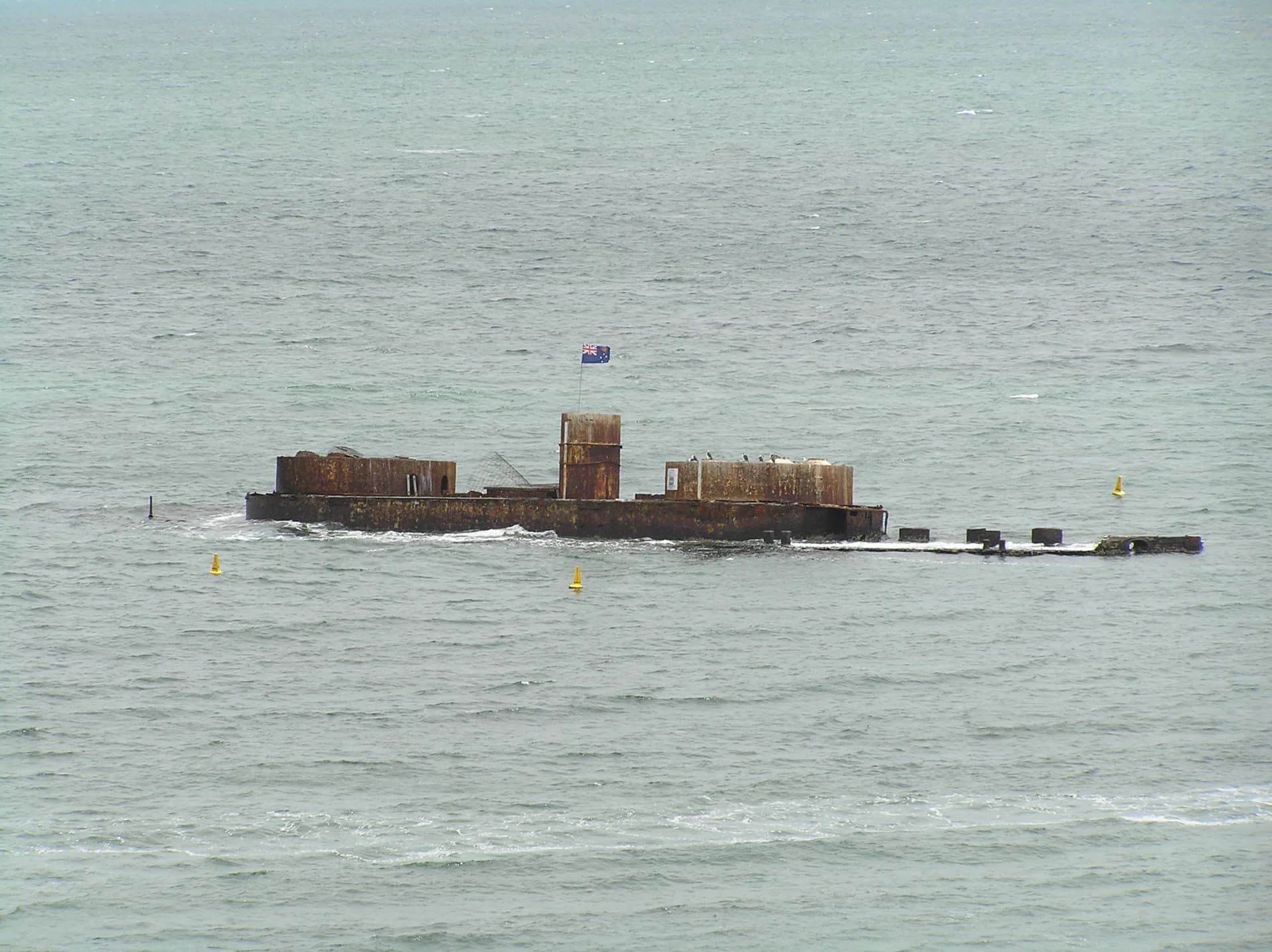
HMVS Cerberus is one of Victoria's most historically significant shipwrecks. Built in 1868, it is the last surviving example of a monitor warship — a specialised class of shallow-draft armoured vessels designed for coastal defence. The wreck sits partially submerged off Half Moon Bay at Black Rock, where it has been slowly deteriorating for over a century.
History
Cerberus was commissioned by the Victorian colonial government in the 1860s as a harbour defence vessel. It was designed to protect Melbourne from the threat of naval attack — a genuine concern during the era of colonial expansion and international tension. The ship was heavily armoured, low in profile, and carried large-calibre guns in rotating turrets — characteristics of the monitor design.
After a long service life, Cerberus was decommissioned in 1924 and sold to a private buyer who intended to use it as a breakwater. It was towed to Half Moon Bay and scuttled near the shore. Over the decades, the wreck has gradually broken apart, though the distinctive armoured turrets and sections of the hull remain visible at low tide.
Diving and Access
HMVS Cerberus is a protected historic shipwreck under the Commonwealth Historic Shipwrecks Act 1976. A 50-metre exclusion zone surrounds the wreck, and entry into this zone without a permit is prohibited. Diving on the wreck is only permitted with approval from Heritage Victoria, and such permits are rarely granted except for research or conservation purposes.
You can, however, observe the wreck from the shore at Half Moon Bay. At low tide, large sections of the hull and turrets are exposed above the waterline, and you can walk out to the wreck across the sand and rock platform. This is a fascinating experience for history enthusiasts, even if you cannot dive it.
The wreck is deteriorating rapidly due to corrosion and wave action. Conservation efforts are ongoing, but the future of Cerberus remains uncertain. It is a poignant reminder of Victoria's maritime heritage and the challenges of preserving underwater cultural sites.
Cerberus Protected Site
HMVS Cerberus is a protected historic shipwreck. A 50-metre exclusion zone applies, and diving on or near the wreck without a Heritage Victoria permit is illegal. Fines and penalties apply. You can observe the wreck from shore at Half Moon Bay, especially at low tide, but do not enter the water near the exclusion zone.
SS Casino
The SS Casino is one of the few shipwrecks in Victoria that is shallow enough to be accessible to confident freedivers and snorkelers. It lies in approximately 9 metres of water off Apollo Bay, making it a popular site for divers visiting the Great Ocean Road.
History
SS Casino was a coastal steamer that ran aground at Apollo Bay during a storm in 1932. The crew abandoned ship, and the vessel broke apart over subsequent weeks. Today, the wreck is scattered across the seabed — sections of the hull, boiler, engine components, and cargo are all visible among the reef and kelp. Marine life has thoroughly colonised the wreck, and it now functions as an artificial reef supporting crayfish, abalone, boarfish, old wives, and schooling fish.
Diving the Casino
The Casino sits close to shore in Apollo Bay, accessible by a short swim from the beach or by boat. The depth of around 9 metres makes it manageable for experienced freedivers, though you should be comfortable diving to that depth repeatedly and be aware of ocean swell and surge, which can be significant depending on conditions.
Visibility at Apollo Bay is typically better than in Port Phillip Bay — often 5-10 metres or more on calm days. The wreck is broken up, so there are no penetration risks, but the site is surrounded by reef structure, kelp, and large boulders, which create excellent habitat for marine life.
The SS Casino is a good introduction to wreck diving for freedivers who are ready to progress beyond pier sites but not yet diving deep offshore wrecks. The combination of historical interest, shallow depth, and abundant marine life makes it a worthwhile stop on any Great Ocean Road dive trip.
For more on diving the Great Ocean Road region, see our Great Ocean Road diving guide.
William Salthouse
The William Salthouse is the oldest known shipwreck in Port Phillip Bay. The ship sank in 1841 near Point Ormond in Elwood, and sections of the wreck were rediscovered in 2002 during dredging operations. The site is now managed as a heritage-protected underwater archaeological site.
History
William Salthouse was a brigantine that sailed between Sydney and Port Phillip in the early colonial period, transporting passengers and cargo. On 25 October 1841, the ship ran aground on a sandbank off Elwood during a storm and broke apart. The crew survived, but the ship was a total loss.
In 2002, marine archaeologists rediscovered sections of the hull and cargo during a survey. The wreck is now protected under the Victorian Heritage Act, and artefacts recovered from the site have been conserved and are held by Heritage Victoria. The site is not diveable due to shallow depth, silt, and protected status, but it is of enormous historical significance as the oldest confirmed wreck in Port Phillip Bay.
Regulations & Permits
Shipwreck diving in Victoria is regulated by Heritage Victoria under the Heritage Act 2017 and by the Commonwealth under the Historic Shipwrecks Act 1976 for wrecks older than 75 years. The rules are strict, and penalties for non-compliance are significant.
Protected Wrecks
Many wrecks in Victorian waters are automatically protected under the Historic Shipwrecks Act if they are 75 years old or older. Some wrecks are also specifically declared protected sites due to their historical, archaeological, or cultural significance. Protected wrecks include:
- HMVS Cerberus (50-metre exclusion zone, diving prohibited without permit)
- William Salthouse (protected archaeological site, diving prohibited)
- J-class submarines (protected but accessible for recreational diving with conditions)
- Numerous other wrecks around the coast, particularly older 19th-century vessels
What You Can and Cannot Do
On non-protected wrecks or wrecks where recreational diving is permitted, you may:
- Observe and photograph the wreck
- Dive on the exterior of the wreck (unless penetration is specifically prohibited)
- Explore the surrounding seabed and marine life
You cannot:
- Remove artefacts, fittings, or any material from a protected wreck (including brass, portholes, anchors, etc.)
- Damage, deface, or interfere with a wreck structure
- Enter a protected zone without a permit (e.g., HMVS Cerberus exclusion zone)
- Use tools or equipment to excavate or salvage items from a wreck site
Penalties for breaching heritage protection laws include fines up to $50,000 and possible imprisonment. If you are unsure whether a wreck is protected, assume it is and check with Heritage Victoria before diving.
Applying for a Permit
If you need to dive a protected wreck for research, education, or conservation purposes, you can apply for a permit through Heritage Victoria. Applications must demonstrate a legitimate reason for accessing the site and include details of your qualifications, dive plan, and intended activities. Recreational diving permits are rarely granted unless the wreck is already open to public access (such as the J-class submarines).
More information is available on the Heritage Victoria website: heritage.vic.gov.au.
Freediving vs Scuba for Wreck Exploration
Wreck diving is traditionally the domain of scuba divers, and for good reason. Most significant wrecks sit at depths beyond comfortable freediving range, and the bottom time required to explore a wreck thoroughly is difficult to achieve on breath-hold. However, freedivers can still explore certain wrecks and develop wreck-diving skills in shallow sites.
Freediving Wrecks
Freedivers can comfortably explore wrecks in depths up to 10-15 metres, depending on skill level and experience. The SS Casino at 9 metres is a good example of a freediveable wreck. Freediving offers several advantages for shallow wreck exploration:
- Silence — No bubbles or regulator noise means more natural encounters with marine life around the wreck
- Mobility — Freedivers can move more fluidly and cover more ground with less drag than scuba divers
- Simplicity — Less equipment to manage and no decompression concerns on shallow wrecks
- Cost — Freediving requires only mask, fins, wetsuit, and weights — no tanks, regulators, or dive computers
The limitation is depth and bottom time. Repeated dives to 9-12 metres are manageable for trained freedivers, but anything beyond 15 metres requires significant skill, and the risks increase substantially. Wrecks at 20+ metres are realistically only accessible to advanced competitive freedivers, and even then, the bottom time is limited to seconds rather than minutes.
Scuba Wreck Diving
Scuba diving is the standard approach for wreck exploration at depth. It allows extended bottom time, penetration diving (where safe and permitted), and detailed exploration of wreck features. The J-class submarines, Ex-HMAS Canberra, and most offshore wrecks require scuba equipment due to their depth and the complexity of the dive.
Scuba divers exploring wrecks should have:
- Advanced Open Water certification or equivalent (minimum)
- Wreck Diving specialty certification (strongly recommended for penetration dives)
- Experience diving in current, low visibility, and deep water
- Proper equipment including dive computer, redundant air source, cutting tool, and torch
- Training in buoyancy control and wreck-specific safety protocols
For a broader comparison of freediving and scuba, see our freediving vs scuba diving guide.
Safety Considerations
Wreck diving introduces hazards that are not present on open-water dives. Entanglement, penetration risks, sharp edges, unstable structures, and disorientation in low visibility all demand additional caution and training.
Penetration Risks
Entering the interior of a wreck is extremely dangerous without proper training. Wrecks have confined spaces, low or zero visibility (due to disturbed silt), overhead environments (no direct route to the surface), and the risk of structural collapse. Penetration diving should only be attempted by divers with wreck diving specialty certification and appropriate equipment, including:
- Primary and backup dive lights
- Redundant air source (pony bottle or independent twin tanks)
- Guideline and reel for navigation
- Cutting tool for entanglement emergencies
For freedivers, penetration diving is never advised. The risk of entanglement or disorientation combined with limited air supply is a recipe for disaster. All freediving on wrecks should be external observation only.
Entanglement
Wrecks are full of trailing lines, fishing nets, cables, and sharp protrusions. Entanglement is a real risk. Always carry a cutting tool (knife or line cutter) and dive with a buddy who can assist if you become caught. Avoid trailing equipment (dangling gauges, loose hoses) and streamline your configuration. Freedivers should be especially cautious — without a tank to stabilise you, it is easy to drift into an overhang or get caught on a cable.
Depth and Currents
Most Victorian wrecks are in depths of 20-30 metres, requiring deep diving skills and awareness of nitrogen narcosis, decompression limits, and increased gas consumption. Offshore wrecks like the J-class submarines are also exposed to Bass Strait currents and swells, which can change rapidly. Always dive with a reputable charter operator, plan your dive conservatively, and be prepared to abort the dive if conditions deteriorate.
General Wreck Diving Safety
- Never dive alone — Always dive with a trained buddy
- Stay within your training and experience level — Do not attempt penetration without proper certification
- Carry a dive light — Even on shallow wrecks, interiors can be dark
- Monitor your air supply — Wreck exploration can be distracting — check your gauge regularly
- Respect the wreck — Do not touch, remove, or damage wreck structures or artefacts
- Check regulations — Ensure the wreck you are diving is not protected or restricted
Frequently Asked Questions
Are there shipwrecks you can snorkel or freedive in Melbourne?
Yes, but options are limited. The SS Casino at Apollo Bay sits in 9 metres of water and is accessible to confident freedivers. Some pier sites around Melbourne have submerged structures that function ecologically like wrecks, though they are not traditional shipwrecks. Most significant wrecks in Port Phillip Bay and along the coast are deeper than 20 metres and require scuba diving to explore safely.
Do you need a permit to dive shipwrecks in Victoria?
Some wrecks are protected under the Heritage Act 2017 or the Historic Shipwrecks Act 1976 and require permits from Heritage Victoria. HMVS Cerberus, for example, has a 50-metre exclusion zone and cannot be dived without authorisation. The J-class submarines are protected but open to recreational diving under certain conditions. Always check the status of a wreck before diving — penalties for diving protected wrecks without permission are severe.
Where are the J-class submarines?
The J-class submarines (J1, J3, J4, J5, J7) were scuttled outside Port Phillip Heads near Barwon Heads in 1926. They sit in 15-30 metres of water approximately 3 nautical miles offshore. They are the only J-class submarines in the world available to recreational divers. Access is by boat charter only, and conditions can be challenging due to exposure to Bass Strait swells and currents.
Can you dive the Ex-HMAS Canberra?
Yes. The Ex-HMAS Canberra was deliberately scuttled in 2009 as an artificial reef dive site off Ocean Grove. It sits upright in 28 metres of water and is one of Victoria's premier scuba dive sites. The wreck is fully colonised by marine life — sponges, soft corals, schools of fish, and rays. Penetration diving is possible for experienced wreck divers. Due to depth, it is a scuba-only site. Several dive charter operators run regular trips from Ocean Grove, Queenscliff, and Barwon Heads.