Port Phillip Bay Marine Life Guide
300+ fish species, seadragons, dolphins, nudibranchs, spider crabs — what lives in Melbourne's bay and where to find it.
Last updated:
Port Phillip Bay is one of Australia's great marine biodiversity hotspots — a fact that surprises most people living on its shores. This semi-enclosed bay, sitting at the doorstep of a city of five million, supports over 300 fish species, 200+ seaweed species, and thousands of invertebrates.
It hosts the largest crab migration on Earth. It is home to the world's densest populations of weedy seadragons. It shelters breeding colonies of bottlenose dolphins and Australian fur seals. And it offers some of the most accessible, rewarding marine encounters anywhere in the world — many within a short drive from the Melbourne CBD.
This guide covers what lives in Port Phillip Bay, where to find it, and when to dive.
Overview
Port Phillip Bay is a large, shallow, semi-enclosed bay covering approximately 1,930 square kilometres. Its narrow entrance — The Rip — connects it to Bass Strait and the Southern Ocean, allowing oceanic water to flow in and mix with the bay's calmer, nutrient-rich environment.
The result is an unusual ecosystem: sheltered enough to support delicate species like seadragons and seahorses, yet connected to the ocean enough to attract pelagic visitors like dolphins, seals, and seasonal fish migrations. The bay's mix of habitat types — seagrass meadows, kelp forests, sponge gardens, sandy plains, rocky reefs, and artificial structures like piers — creates niches for an extraordinary range of species.
Despite urbanisation and historical habitat loss, Port Phillip Bay remains a globally significant marine environment. Over 85 species found in the bay are listed as protected or threatened, and ongoing conservation efforts aim to restore lost habitats like shellfish reefs and kelp forests.
Habitat Types
Understanding the bay's habitats helps you know what to expect at different dive sites.
Seagrass Meadows
Vast underwater meadows of seagrass — primarily Zostera and Amphibolis species — carpet much of the bay's shallow areas. Seagrass is critical habitat for seahorses, pipefish, juvenile fish, crabs, and the prey species that feed larger predators. These meadows also stabilise the seafloor and filter nutrients from the water. Unfortunately, Port Phillip Bay has lost around 70% of its historical seagrass cover due to urbanisation, dredging, and nutrient runoff. Conservation efforts are now focused on protecting and restoring what remains.
Kelp Forests
Kelp forests — dominated by crayweed (Phyllospora comosa) and other brown algae — fringe rocky reefs and pier pylons, particularly on the bay's southern and eastern shores. Kelp provides shelter, food, and nursery habitat for fish, seadragons, and invertebrates. Like seagrass, kelp forests in Port Phillip Bay have declined significantly. The Victorian government and conservation organisations are working on kelp restoration projects to bring back this vital habitat.
Sponge Gardens
Melbourne's piers — particularly Flinders, Portsea, and Blairgowrie — support spectacular sponge gardens on their pylons. Bright orange, yellow, red, and purple sponges coat every timber surface, creating one of the most colourful underwater environments in temperate Australian waters. These sponge communities support dense populations of nudibranchs, crabs, fish, and other invertebrates.
Sandy Plains
Much of the bay floor is sandy bottom, seemingly barren at first glance. But sand plains support rays, banjo sharks (fiddler rays), flathead, flounder, sand crabs, sea stars, and buried molluscs. During the winter spider crab migration, these sand plains become carpeted with thousands of moulting crabs.
Rock Walls and Artificial Reefs
Rocky reefs and artificial structures — piers, groynes, shipwrecks, and breakwaters — concentrate marine life. These structures provide hard substrate for sessile organisms like sponges, ascidians, and bryozoans, which in turn attract grazers, predators, and shelter-seeking species. Piers in particular act as artificial reefs and are some of the most accessible and productive dive sites in the bay.
Weedy Seadragons
The weedy seadragon (Phyllopteryx taeniolatus) is Victoria's official marine emblem, and Port Phillip Bay supports some of the world's healthiest populations. These ethereal fish — related to seahorses — drift through kelp forests and over seagrass beds, their leaf-like appendages providing near-perfect camouflage.
Weedy seadragons grow up to 45 centimetres long and feed on tiny crustaceans and mysid shrimp. Unlike seahorses, they cannot grip with their tails and are poor swimmers, drifting with the current rather than actively hunting. This makes them vulnerable to habitat loss and collection, and they are fully protected under Victorian law.
Where to Find Them
Weedy seadragons are most reliably seen at Melbourne's Mornington Peninsula piers. Flinders Pier supports one of the densest populations in Australia and was featured in the BBC's Blue Planet II documentary. Portsea Pier, Rye Pier, and Blairgowrie Pier also host healthy seadragon populations.
Look for them around pier pylons, in kelp forests, over seagrass beds, and near structured reef. They are present year-round, but winter (June-August) is breeding season when males carry bright pink egg clusters on their tails — a remarkable sight.
For a detailed guide to finding and photographing weedy seadragons, see our guide to freediving with weedy seadragons in Melbourne.
Conservation
Seadragon populations are under pressure from habitat loss, pollution, and illegal collection. They are fully protected in Victoria — it is illegal to catch, harm, or harass them. If you photograph a seadragon, you can contribute to conservation research by submitting your images to the VNPA's Dragon Quest citizen science program, which tracks individual seadragons using their unique markings.
Seahorses
Port Phillip Bay is home to several seahorse species, though they are far more difficult to find than their larger seadragon cousins. Seahorses are small (5-15 centimetres), masters of camouflage, and spend most of their time clinging motionless to seagrass stems, kelp fronds, or sponge growth.
Species
The most common species in the bay is the short-headed seahorse (Hippocampus breviceps), also known as the short-snouted seahorse. They are typically brownish or greyish, blending into seagrass and kelp. The big-belly seahorse (Hippocampus abdominalis), Australia's largest seahorse species (growing up to 35 centimetres), is occasionally seen but is less common in Port Phillip Bay than in oceanic waters.
Where and How to Spot Them
Seahorses are found around pier pylons, in seagrass beds, and in kelp. The key to spotting them is slowing down and scanning methodically — they are small, perfectly camouflaged, and motionless. Look along seagrass stems and the thinner branches of sponge growth on pier pylons. A torch or underwater light helps reveal their form.
Flinders Pier, Portsea Pier, and Rye Pier are reliable seahorse spots. Night dives increase your chances, as seahorses are slightly more active after dark.
Nudibranchs
Nudibranchs — shell-less sea slugs — are one of the hidden treasures of Port Phillip Bay. Over 200 species have been recorded in the bay, ranging from brilliant neon blues and yellows to cryptic camouflage species barely visible against their substrate.
Nudibranchs are carnivores, feeding on sponges, bryozoans, hydroids, and even other nudibranchs. Their bright colours are often warning signals — many species store toxins from their prey and advertise their distastefulness with vivid patterns.
Where to Find Them
Nudibranchs are found wherever there is hard substrate and sessile invertebrate growth. The sponge-covered pylons at Flinders, Portsea, and Blairgowrie piers are nudibranch hotspots. Blairgowrie in particular is known as the nudibranch capital of Melbourne, with over 100 species recorded at the site.
Some of the most commonly seen species include:
- Tambja verconis — Striking blue-and-yellow stripes
- Chromodoris westraliensis — Vivid purple body with orange edges
- Hypselodoris obscura — Translucent white with purple and orange markings
- Ceratosoma brevicaudatum — Large, purple-edged nudibranch with distinctive rhinophores
- Flabellina species — Small, colourful aeolids with feathery cerata
How to Find Nudibranchs
Nudibranch hunting requires patience, a sharp eye, and often a macro lens. They range from thumbnail-sized to barely visible without magnification. Work slowly over sponge-covered surfaces, scanning every crevice and patch of colour. A torch or dive light helps reveal their vivid colours and fine details.
Octopus & Cuttlefish
Port Phillip Bay is home to several species of octopus and cuttlefish — intelligent, adaptable, and endlessly fascinating to observe.
Common Sydney Octopus
The common Sydney octopus (Octopus tetricus) is the most frequently encountered octopus in the bay. They are typically found in dens among rubble, in crevices, or under ledges. A pile of empty shells — known as a midden — outside a hole is a telltale sign of an octopus den.
These octopuses are intelligent and curious. If you approach slowly and avoid sudden movements, they will often emerge from their dens to investigate you. Their ability to change colour and texture in an instant is mesmerising — they can shift from smooth and pale to rough and mottled brown in a fraction of a second.
Giant Australian Cuttlefish
Giant Australian cuttlefish (Sepia apama) are present in the bay, particularly around pier pylons and structured reef. They are larger and more robust than octopus, with the ability to hover in the water column using undulating fins. Cuttlefish are masters of camouflage and communication — their skin can display shifting patterns, waves of colour, and hypnotic pulses.
Cuttlefish are most commonly seen in autumn and winter. During breeding season, males compete for females by displaying vivid colour patterns and sparring with rivals.
Blue-Ringed Octopus
The southern blue-ringed octopus (Hapalochlaena maculosa) is present in Port Phillip Bay, particularly at pier sites and rocky reefs. They are small (12-20 centimetres) and usually well-camouflaged, displaying their brilliant blue rings only when threatened.
Blue-ringed octopus are venomous — their bite carries a potentially fatal neurotoxin with no antivenom available. However, they are not aggressive and will only bite if handled or accidentally trapped. The rule is simple: never touch any octopus, and never put your hands into crevices or pick up shells you can't see into.
Blue-Ringed Octopus Safety
Blue-ringed octopus are present at pier dive sites and rocky reefs year-round, and are more commonly seen at night. They are small, shy, and only display their warning rings when disturbed. Never pick up shells, rocks, or any octopus. Never put your hands into holes or crevices. If you spot one, observe from a safe distance and appreciate one of nature's most striking warning displays.
Where and When to Find Them
Octopus and cuttlefish are found around pier pylons, rocky reefs, rubble piles, and sand-reef interfaces. Night dives are particularly productive — octopus leave their dens to hunt, and cuttlefish become more active. Flinders Pier and Blairgowrie Pier are reliable sites for both species.
Rays & Sharks
Port Phillip Bay is home to several species of rays and small sharks — all harmless to humans and remarkable to encounter.
Smooth Rays
Smooth rays (Bathytoshia brevicaudata) are large stingrays with disc-shaped bodies and wingspans that can exceed 2 metres. They glide gracefully over sand flats and seagrass beds, often burying themselves partially in the sand. Smooth rays feed on molluscs, crustaceans, and worms, which they crush with their flattened teeth.
While they do have a venomous barb on their tail, smooth rays are docile and pose no threat to divers who give them space. They are often encountered at pier sites and during the spider crab migration, when they feed on freshly moulted crabs.
Port Jackson Sharks
Port Jackson sharks (Heterodontus portusjacksoni) are small, slow-moving bottom-dwellers with distinctive brown harness-like markings. They grow to about 1.5 metres long and feed on hard-shelled prey like sea urchins, crabs, and molluscs, which they crush with their blunt teeth.
Port Jackson sharks are most commonly seen in winter and spring when they migrate into shallow waters to breed. They rest on the sandy bottom during the day, often partially hidden under ledges or between pier pylons. They are completely harmless and can be approached closely.
Wobbegongs
Spotted wobbegongs (Orectolobus maculatus) — small carpet sharks with mottled camouflage and a fringe of skin flaps around the head — are occasionally seen resting on the bottom at reef sites and pier pylons. They are ambush predators, lying motionless on the seafloor and striking at passing fish. Despite their fearsome hunting style, they are not aggressive towards divers.
Banjo Sharks (Fiddler Rays)
Banjo sharks (Trygonorrhina species), also called fiddler rays or guitarfish, are small, flat-bodied sharks that live on sandy bottoms. They are beautifully patterned with brown and cream markings and grow to about 1 metre long. Banjo sharks are common in Port Phillip Bay but are easily overlooked due to their excellent camouflage against sand.
Eagle Rays
Southern eagle rays (Myliobatis tenuicaudatus) occasionally visit Port Phillip Bay, particularly in summer. They are elegant, fast-swimming rays with diamond-shaped bodies and long whip-like tails. Spotting an eagle ray cruising through the water column is a highlight of any dive in the bay.
Dolphins & Seals
Port Phillip Bay is home to a resident population of bottlenose dolphins and is visited regularly by Australian fur seals from colonies in Bass Strait. Both species can be encountered by freedivers and divers, particularly at specific sites and times of year.
Bottlenose Dolphins
A resident population of around 100 bottlenose dolphins (Tursiops australis) lives in Port Phillip Bay year-round. These dolphins feed on fish, squid, and cephalopods, and are often seen hunting in groups. They are highly intelligent, social, and curious — encounters with dolphins in the bay can be magical, though they are unpredictable.
Dolphins are most often spotted in open water, channels, and near The Rip (the bay entrance), but they can turn up anywhere. Early morning and late afternoon are the best times to see them actively hunting. For more on encountering dolphins in Melbourne, see our guide to swimming with seals and dolphins.
Australian Fur Seals
Australian fur seals (Arctocephalus pusillus doriferus) regularly visit Port Phillip Bay, particularly during winter when they follow fish schools into the bay. The nearest breeding colony is at Seal Rocks near Phillip Island, and seals from this colony range widely in search of food.
Seal encounters are most common at sites near the bay entrance — Portsea, Queenscliff, and Point Lonsdale — but they occasionally turn up at pier sites and other locations. During the spider crab migration, seals are often seen feeding on freshly moulted crabs.
Seals are playful, curious, and surprisingly bold underwater. They may approach divers and freedivers, sometimes circling or mimicking movements. However, they are wild animals and should be treated with respect — never chase, corner, or touch a seal.
Crabs & Invertebrates
Port Phillip Bay supports a remarkable diversity of crabs, sea stars, urchins, and other invertebrates.
Giant Spider Crabs
The giant spider crab (Leptomithrax gaimardii) is the star of the bay's most extraordinary wildlife event — the annual winter spider crab migration. Thousands of melon-sized crabs gather in shallow water to moult simultaneously, creating the largest crab aggregation on Earth.
Spider crabs are present in the bay year-round, but the mass moulting event typically occurs between late May and mid-June. The exact timing and location vary each year. For full details, see our guide to the spider crab migration in Melbourne.
Decorator Crabs
Decorator crabs — including spider crabs and smaller species — attach pieces of sponge, algae, hydroids, and bryozoans to their shells for camouflage. The result is a walking garden that blends perfectly into sponge-covered pier pylons. Decorator crabs are particularly common at night dives when they emerge from hiding to forage.
Hermit Crabs
Hermit crabs are abundant on sandy bottoms and around reef structures, living in discarded mollusc shells. They are active scavengers and play an important role in the bay's ecosystem. At night, sandy areas can be covered with dozens of hermit crabs marching across the bottom.
Sea Stars and Urchins
Port Phillip Bay is home to numerous sea star species, including the striking eleven-armed sea star (Coscinasterias muricata), which feeds on mussels, barnacles, and other invertebrates. Purple sea urchins (Heliocidaris erythrogramma) are common on rocky reefs and around pier pylons, grazing on algae. Long-spined sea urchins (Centrostephanus rodgersii), with black spines up to 30 centimetres long, are occasionally seen but are less common in the bay than on Victoria's oceanic reefs.
Molluscs
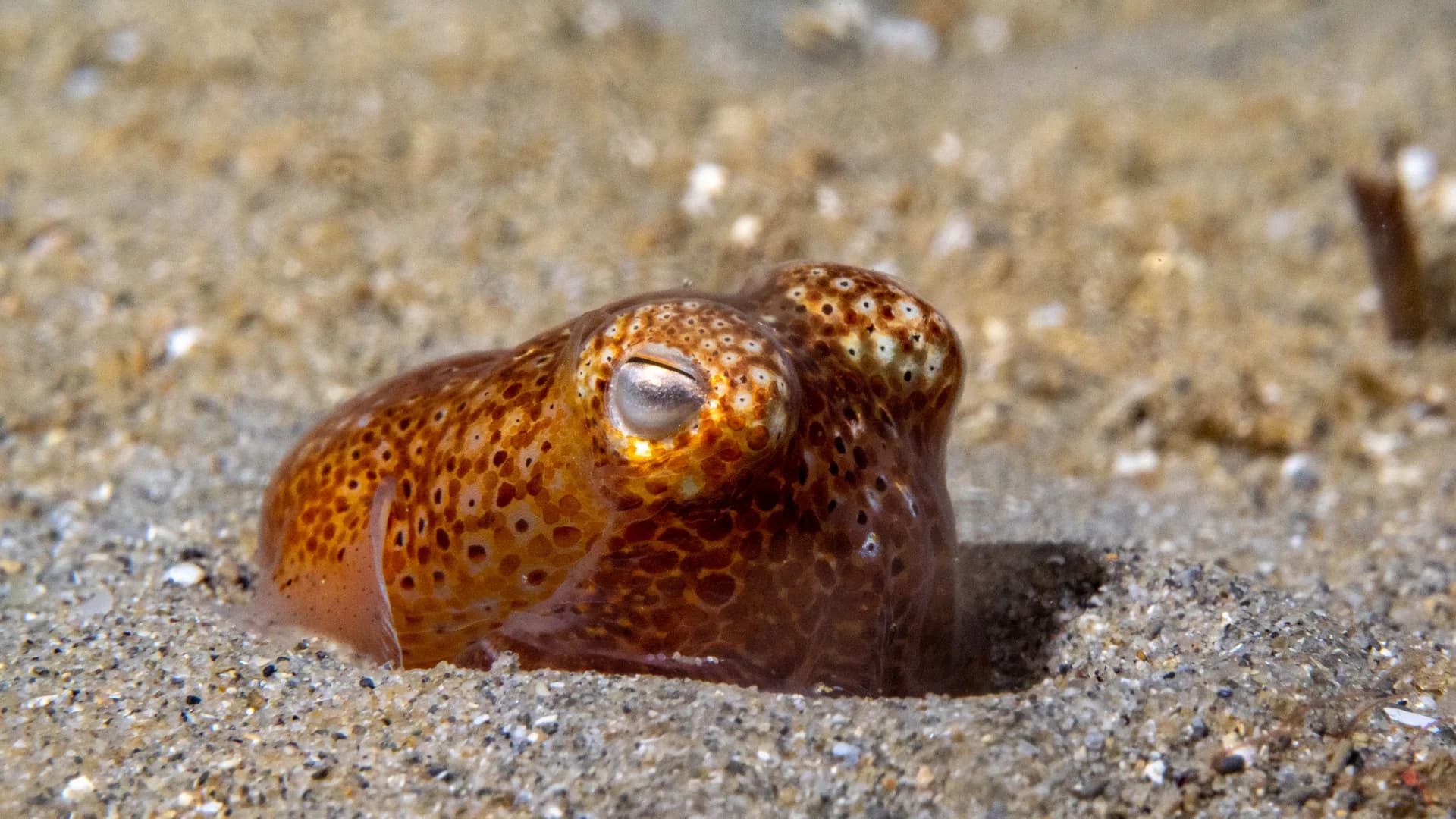
The bay supports a diverse range of molluscs, from tiny cowries and cone shells to large abalone and scallops. Dumpling squid (Euprymna tasmanica) — also called bobtail squid — are small, round, luminous cephalopods that bury in sand during the day and emerge at night. They are one of the most charming creatures you can encounter on a night dive.
Marine Life Calendar
Different species and behaviours occur at different times of year in Port Phillip Bay. Here's what to look for each season.
Summer (December-February)
- Warmest water — 18-22°C, making for comfortable dives
- Cuttlefish breeding — Males compete with vivid displays
- Abundant fish life — Juvenile fish recruit into seagrass and kelp
- Dolphins active — Feeding on summer fish schools
- Plankton blooms — Can reduce visibility but support the food chain
Autumn (March-May)
- Improving visibility — Water clarity increases as plankton blooms subside
- Cuttlefish common — Post-breeding adults still present
- Nudibranchs abundant — Many species laying egg ribbons
- Good all-round conditions — Mild weather, decent water temperature (15-18°C)
Winter (June-August)
- Best visibility — Clearest water of the year, often 8-12 metres or more
- Weedy seadragon breeding — Males carry bright pink egg clusters on their tails
- Spider crab migration — Late May to mid-June, the largest crab migration on Earth
- Port Jackson sharks arrive — Migrate into shallow water to breed
- Fur seals common — Visiting from Bass Strait colonies
- Cold water — 10-13°C, requiring 7mm wetsuits or drysuits
Spring (September-November)
- Seadragon eggs hatching — Tiny juvenile seadragons may be spotted
- Port Jackson sharks still present — Resting on sandy bottoms
- Fish schools rebuild — Small fish aggregate around piers and reefs
- Water warming — Temperatures rise from 13°C to 16°C+
- Good visibility continues — Before summer plankton blooms
For a detailed month-by-month guide to diving conditions, see our guide to the best time to dive in Melbourne.
Conservation
Port Phillip Bay's marine life faces significant threats from urbanisation, habitat loss, pollution, and climate change. Understanding these threats — and the conservation efforts underway — is essential for anyone diving in the bay.
Kelp Forest Decline
Kelp forests have declined dramatically across southern Australia, and Port Phillip Bay is no exception. Crayweed — a species of large brown kelp that once dominated rocky reefs and pier pylons — has disappeared from large sections of the bay. The causes include warming water temperatures, increased storm intensity, and overgrazing by sea urchins.
Kelp restoration projects are underway, led by organisations like The Nature Conservancy and Victorian government agencies. These projects involve transplanting healthy kelp to degraded sites and removing excess urchins to allow kelp recovery.
Shellfish Reef Restoration
Port Phillip Bay was once home to extensive reefs of native oysters and mussels. These reefs provided critical habitat for fish, crabs, and other marine life, and filtered vast quantities of water. Over 99% of these reefs were destroyed by dredging, overfishing, and urban development.
The Nature Conservancy and partners are working to restore shellfish reefs in the bay through the Reef Restoration Project. By building artificial reefs and seeding them with native oysters, they aim to bring back this lost habitat and improve water quality.
Marine Sanctuary Network
Victoria's marine sanctuary network includes several no-take marine reserves in Port Phillip Bay where all fishing and collecting is prohibited. These sanctuaries — including Point Cooke, Jawbone, and Ricketts Point — protect critical habitat and act as breeding refuges for fish and invertebrates.
For a detailed guide to these sanctuaries and where to dive in them, see our guide to Melbourne's marine sanctuaries.
Threats to Marine Life
The main threats facing Port Phillip Bay's marine ecosystems include:
- Habitat loss — 70% of seagrass and significant kelp cover lost to urbanisation and dredging
- Pollution — Nutrient runoff, plastics, and stormwater contamination degrade water quality
- Climate change — Warming water, marine heatwaves, and ocean acidification stress marine life
- Invasive species — Non-native species like the Northern Pacific seastar compete with native species
- Overfishing — Historical overfishing has depleted key species and disrupted food webs
How You Can Help
As a freediver or diver in Port Phillip Bay, you can contribute to conservation by: reporting sightings of rare species to citizen science programs like Dragon Quest (seadragons) and Reef Life Survey; avoiding damage to kelp, seagrass, and reef habitat; removing any rubbish you encounter underwater; and supporting marine conservation organisations working to restore the bay's ecosystems.
Frequently Asked Questions
How many species live in Port Phillip Bay?
Over 300 fish species, 200+ seaweed species, and thousands of invertebrate species. Despite being a semi-enclosed bay, it supports extraordinary biodiversity due to its variety of habitats — seagrass meadows, kelp forests, sponge gardens, sandy plains, and rocky reefs.
What is the most interesting marine life in Port Phillip Bay?
Weedy seadragons (Victoria's marine emblem), the giant spider crab migration (largest in the world), giant cuttlefish, over 200 nudibranch species, Australian fur seals, and bottlenose dolphins are among the highlights. The bay's diversity rivals many tropical reefs.
Where can you see seadragons in Melbourne?
Flinders Pier, Portsea Pier, and Blairgowrie Pier are the most reliable sites. Seadragons live in kelp forest and seagrass habitats. Winter (June-August) is breeding season when males carry eggs.
Is Port Phillip Bay good for marine life?
Excellent. The bay's mix of habitats — seagrass, kelp, sponge gardens, sand, reef — supports remarkable diversity. Melbourne's pier dive sites concentrate marine life in accessible locations. Over 85 species in the bay are listed as protected or threatened, highlighting its conservation significance.